At $80,000 Income in Ontario, Your $8,000 FHSA Contribution Returns $2,480 Cash, Here's How to Use It
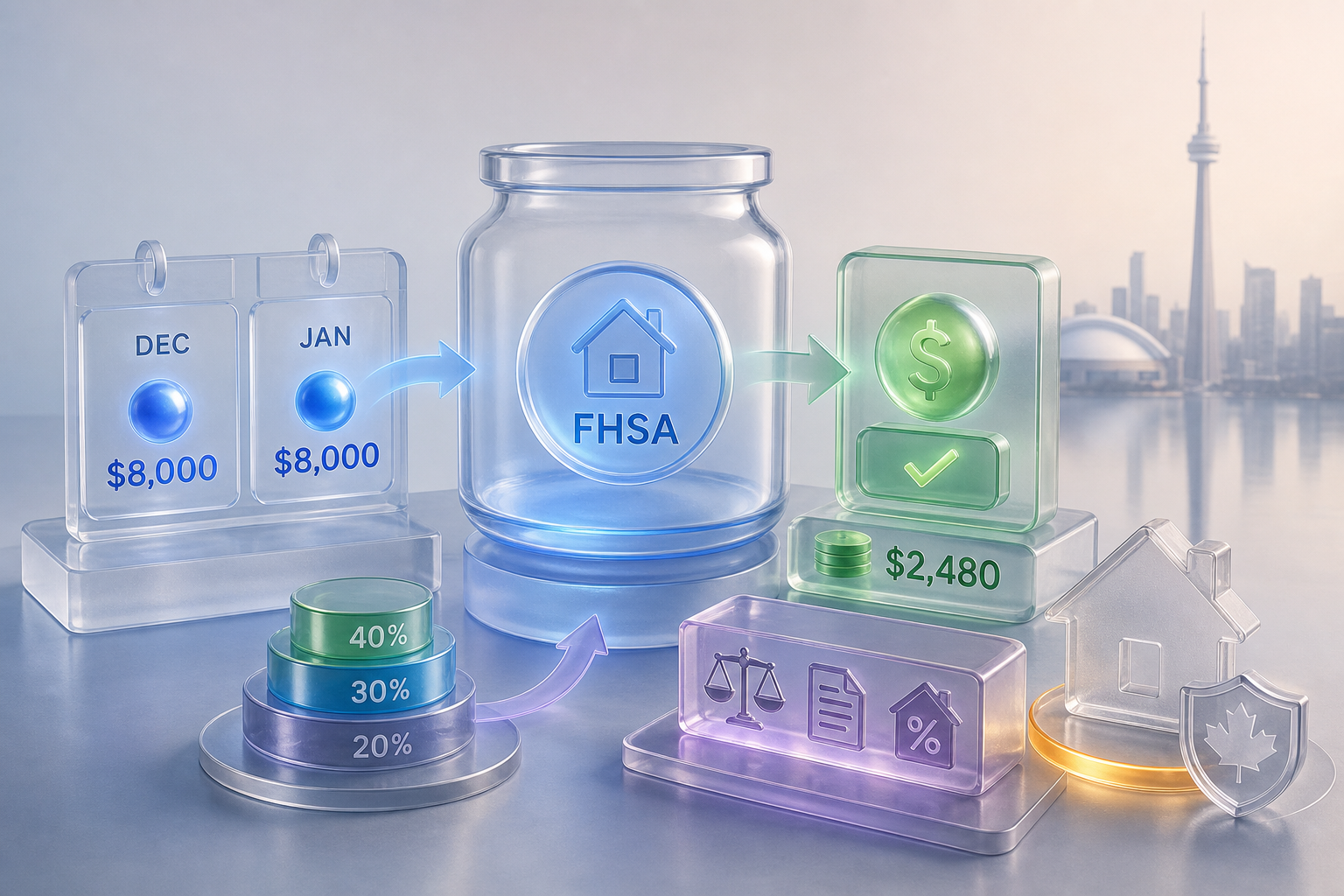
Sophia put $8,000 into her FHSA on December 28, 2025, and by March 2026, the CRA deposited $2,480 into her chequing account. She took that money, added $520 from her tax-free savings account, and put the entire $3,000 toward her RRSP contribution for 2026. By December, she'd collected another $888 refund from that. In 16 months, what started as one $8,000 contribution had put $3,368 of government money into her accounts. That loop is now repeatable for the next four years.
The FHSA works by combining the RRSP's deduction on the way in with the TFSA's tax-free withdrawal on the way out. You put in $8,000, you deduct $8,000 from your taxable income, and when you pull the money for a home purchase, you pay zero tax on growth or principal. The refund you collect in the tax year following your contribution is not theoretical tax savings spread over decades. It's cash, deposited within weeks of filing.
What the Refund Looks Like at Three Income Levels
At $60,000 of taxable income in Ontario, the combined federal and provincial marginal rate sits around 29.6%. An $8,000 contribution returns roughly $2,372.
At $80,000, you're at 31.0% marginal. Same $8,000 contribution, $2,480 back.
At $110,000, you're in the 39.3% bracket for part of that income. The refund climbs to $3,144 on the same contribution.
The gap widens fast. A $50,000 difference in income translates to a $772 difference in refund on identical contributions. The FHSA is more valuable the higher you earn, which is unusual for housing policy but consistent with how all tax-deductible contributions work.
What matters more than the size of the refund is what you do with it. Most people treat a tax refund as bonus spending money. That approach leaves the entire compounding upside on the table. The refund is not a gift. It is deferred cash flow that only becomes useful if it gets redirected.
Two Paths for the Refund
Path A: you take the $2,480 and put it into next year's FHSA contribution. You've now funded 31% of the following year's $8,000 limit without touching new income. Do this for three years and the refund alone covers nearly $7,500 of your total $24,000 contributions. You're borrowing from the government at 0%, using tax policy as a savings accelerator.
Path B: you set the refund aside in a high-interest savings account earmarked for closing costs. In Ontario, a $550,000 home (roughly the median resale price in Hamilton or London as of early 2026) carries about $8,475 in provincial land transfer tax, plus $2,000, $2,500 for legal fees, title insurance, and disbursements. That's $11,000 in non-negotiable cash due on closing day, separate from your down payment. Three years of FHSA refunds at the $80,000 income level gets you $7,440 of that $11,000, reducing the amount you need to scramble for in the final weeks before possession.
Both paths treat the refund as part of the home-purchase capital stack. Neither treats it as discretionary income.
When Timing Shifts the Math
You can contribute to an FHSA in December 2025 and claim the deduction on your 2025 tax return, filed in early 2026. Or you can contribute in December 2025 and carry the deduction forward to 2026 if you expect a raise or bonus that will push you into a higher bracket. The contribution itself happens when you write the cheque. The deduction is a separate decision, claimable in the year you contribute or any future year.
That timing flexibility is worth money if your income is variable. A December 2025 contribution on a $75,000 salary, with the deduction delayed until March 2026 when a promotion brings you to $95,000, shifts your refund from roughly $2,360 to $2,992. Same $8,000, but you've captured an extra $632 by waiting three months to file the paperwork.
The FHSA refund is one of the few housing subsidies that scales directly with your contribution behavior and reverses the usual advice to spend windfalls. Keep it in the loop and the math starts working in multiples.



Sophia put $8,000 into her FHSA on December 28, 2025, and by March 2026, the CRA deposited $2,480 into her chequing account. She took that money, added $520 from her tax-free savings account, and put the entire $3,000 toward her RRSP contribution for 2026. By December, she'd collected another $888 refund from that. In 16 months, what started as one $8,000 contribution had put $3,368 of government money into her accounts. That loop is now repeatable for the next four years.
The FHSA works by combining the RRSP's deduction on the way in with the TFSA's tax-free withdrawal on the way out. You put in $8,000, you deduct $8,000 from your taxable income, and when you pull the money for a home purchase, you pay zero tax on growth or principal. The refund you collect in the tax year following your contribution is not theoretical tax savings spread over decades. It's cash, deposited within weeks of filing.
What the Refund Looks Like at Three Income Levels
At $60,000 of taxable income in Ontario, the combined federal and provincial marginal rate sits around 29.6%. An $8,000 contribution returns roughly $2,372.
At $80,000, you're at 31.0% marginal. Same $8,000 contribution, $2,480 back.
At $110,000, you're in the 39.3% bracket for part of that income. The refund climbs to $3,144 on the same contribution.
The gap widens fast. A $50,000 difference in income translates to a $772 difference in refund on identical contributions. The FHSA is more valuable the higher you earn, which is unusual for housing policy but consistent with how all tax-deductible contributions work.
What matters more than the size of the refund is what you do with it. Most people treat a tax refund as bonus spending money. That approach leaves the entire compounding upside on the table. The refund is not a gift. It is deferred cash flow that only becomes useful if it gets redirected.
Two Paths for the Refund
Path A: you take the $2,480 and put it into next year's FHSA contribution. You've now funded 31% of the following year's $8,000 limit without touching new income. Do this for three years and the refund alone covers nearly $7,500 of your total $24,000 contributions. You're borrowing from the government at 0%, using tax policy as a savings accelerator.
Path B: you set the refund aside in a high-interest savings account earmarked for closing costs. In Ontario, a $550,000 home (roughly the median resale price in Hamilton or London as of early 2026) carries about $8,475 in provincial land transfer tax, plus $2,000, $2,500 for legal fees, title insurance, and disbursements. That's $11,000 in non-negotiable cash due on closing day, separate from your down payment. Three years of FHSA refunds at the $80,000 income level gets you $7,440 of that $11,000, reducing the amount you need to scramble for in the final weeks before possession.
Both paths treat the refund as part of the home-purchase capital stack. Neither treats it as discretionary income.
When Timing Shifts the Math
You can contribute to an FHSA in December 2025 and claim the deduction on your 2025 tax return, filed in early 2026. Or you can contribute in December 2025 and carry the deduction forward to 2026 if you expect a raise or bonus that will push you into a higher bracket. The contribution itself happens when you write the cheque. The deduction is a separate decision, claimable in the year you contribute or any future year.
That timing flexibility is worth money if your income is variable. A December 2025 contribution on a $75,000 salary, with the deduction delayed until March 2026 when a promotion brings you to $95,000, shifts your refund from roughly $2,360 to $2,992. Same $8,000, but you've captured an extra $632 by waiting three months to file the paperwork.
The FHSA refund is one of the few housing subsidies that scales directly with your contribution behavior and reverses the usual advice to spend windfalls. Keep it in the loop and the math starts working in multiples.
Read Next
How Dual Citizens Can Claim RESP Tax Benefits Without Form 3520 Reporting
Bond Markets Are Pricing In Recovery, Not the 1970s Replay Already Underway
Why Fortress Tells Private Credit Lenders to Stop Chasing AI Data Centre Deals
Canada's Tax Code Punishes Work and Rewards Wealth Hoarding: Four Reforms That Would Actually Fix It