Canada's Housing Fix Requires $1.7 Trillion, Which Could Make Borrowing More Expensive
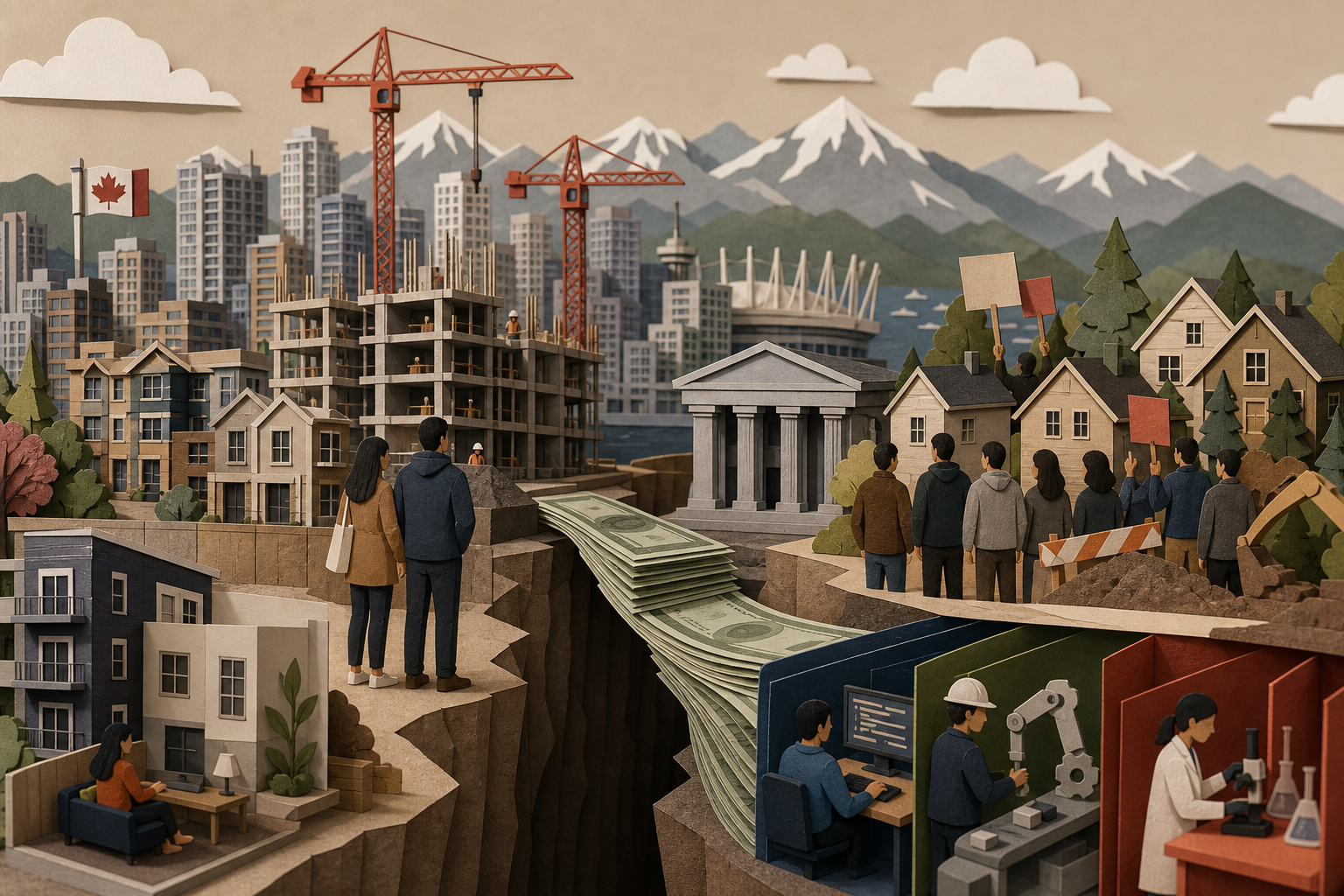
The construction crane count in Vancouver and Toronto has tripled since 2021, yet a two-bedroom condo that sold for $420,000 in 2015 now lists for $780,000. More supply has not meant lower prices, and the reason sits in a spreadsheet at the Canada Mortgage and Housing Corporation: we are not building enough, and we are not even close.
Restoring housing affordability to early-2000s levels demands $1.7 trillion in new residential investment by 2035. That figure, published by CMHC analysts in early 2026, requires doubling the current construction spend as a share of GDP. Canada has never sustained that rate outside wartime mobilization. The gap is not 10% more units or 20% faster permitting. The gap is 3.5 million homes that do not exist and will not exist under current trajectories, even with Ottawa's $4 billion Housing Accelerator Fund and the GST rebate on purpose-built rentals.
The capital problem nobody wants to name
Doubling residential investment means doubling the flow of money into housing. That capital has to come from somewhere. Pension funds, insurers, and foreign institutional buyers already allocate record percentages to Canadian real estate. Asking them to double down competes directly with every other claim on that money: decarbonization retrofits for aging infrastructure, EV battery plants, the technology sector's endless appetite for cheap credit.
The financial system does not treat these as separate pots. A pension fund looking at a 6.2% return on a purpose-built rental tower in Kitchener is simultaneously looking at a 7.1% return on a US data center project or a 5.8% green bond. When housing becomes the single largest capital sink in the economy, the price of all that borrowing moves. Five-year fixed mortgage rates sat at 1.79% in early 2021. In July 2026 they hover near 5.4%, and the structural demand created by a $1.7 trillion buildout acts as a floor under that number even if inflation stays at target.
The Bank of Canada can lower the overnight rate all it wants. If the construction sector is inhaling $170 billion a year in financing, the term premium on long-duration loans does not care what the policy rate says.
The retirement-portfolio problem
Here is the thing almost nobody says out loud: making housing affordable again means making housing worth less. A 47-year-old homeowner in Oakville who bought in 2009 for $390,000 now sits on a property assessed at $1.1 million. That equity is her retirement. It is the down payment for her daughter's first home, the safety net if long-term care becomes necessary, the reason she did not max her RRSP contributions for fifteen years.
Flooding the market with 3.5 million new units lowers prices. That is the mechanism. But it also vaporizes paper wealth for 9.3 million Canadian households who own their primary residence and have structured their entire financial life around its appreciation. The political system has spent two decades telling those households that real estate is the safest wealth-building tool available. Reversing that message, even gently, means confronting millions of voters who feel promised something they now will not get.
Where the argument breaks
The counterargument, repeated often by housing advocates, is that we can build supply without crashing prices if we phase the construction intelligently and manage demand through speculation taxes and short-term rental clampdowns. Maybe. The historical record is thin. No G7 country has ever added housing supply at this pace while simultaneously protecting existing owner equity. Japan tried in the 1990s and succeeded at the supply part. Prices fell 40% in real terms over a decade.
The $1.7 trillion figure is not a policy proposal. It is an invoice for decisions we did not make between 2005 and 2020, when zoning reform was politically impossible and foreign capital treated Vancouver condos like gold bars. Paying that invoice now means someone loses. Either new buyers stay locked out, or existing owners take a haircut, or the entire economy accepts structurally higher borrowing costs as the permanent price of fixing this.
We have picked the third option without admitting it.



The construction crane count in Vancouver and Toronto has tripled since 2021, yet a two-bedroom condo that sold for $420,000 in 2015 now lists for $780,000. More supply has not meant lower prices, and the reason sits in a spreadsheet at the Canada Mortgage and Housing Corporation: we are not building enough, and we are not even close.
Restoring housing affordability to early-2000s levels demands $1.7 trillion in new residential investment by 2035. That figure, published by CMHC analysts in early 2026, requires doubling the current construction spend as a share of GDP. Canada has never sustained that rate outside wartime mobilization. The gap is not 10% more units or 20% faster permitting. The gap is 3.5 million homes that do not exist and will not exist under current trajectories, even with Ottawa's $4 billion Housing Accelerator Fund and the GST rebate on purpose-built rentals.
The capital problem nobody wants to name
Doubling residential investment means doubling the flow of money into housing. That capital has to come from somewhere. Pension funds, insurers, and foreign institutional buyers already allocate record percentages to Canadian real estate. Asking them to double down competes directly with every other claim on that money: decarbonization retrofits for aging infrastructure, EV battery plants, the technology sector's endless appetite for cheap credit.
The financial system does not treat these as separate pots. A pension fund looking at a 6.2% return on a purpose-built rental tower in Kitchener is simultaneously looking at a 7.1% return on a US data center project or a 5.8% green bond. When housing becomes the single largest capital sink in the economy, the price of all that borrowing moves. Five-year fixed mortgage rates sat at 1.79% in early 2021. In July 2026 they hover near 5.4%, and the structural demand created by a $1.7 trillion buildout acts as a floor under that number even if inflation stays at target.
The Bank of Canada can lower the overnight rate all it wants. If the construction sector is inhaling $170 billion a year in financing, the term premium on long-duration loans does not care what the policy rate says.
The retirement-portfolio problem
Here is the thing almost nobody says out loud: making housing affordable again means making housing worth less. A 47-year-old homeowner in Oakville who bought in 2009 for $390,000 now sits on a property assessed at $1.1 million. That equity is her retirement. It is the down payment for her daughter's first home, the safety net if long-term care becomes necessary, the reason she did not max her RRSP contributions for fifteen years.
Flooding the market with 3.5 million new units lowers prices. That is the mechanism. But it also vaporizes paper wealth for 9.3 million Canadian households who own their primary residence and have structured their entire financial life around its appreciation. The political system has spent two decades telling those households that real estate is the safest wealth-building tool available. Reversing that message, even gently, means confronting millions of voters who feel promised something they now will not get.
Where the argument breaks
The counterargument, repeated often by housing advocates, is that we can build supply without crashing prices if we phase the construction intelligently and manage demand through speculation taxes and short-term rental clampdowns. Maybe. The historical record is thin. No G7 country has ever added housing supply at this pace while simultaneously protecting existing owner equity. Japan tried in the 1990s and succeeded at the supply part. Prices fell 40% in real terms over a decade.
The $1.7 trillion figure is not a policy proposal. It is an invoice for decisions we did not make between 2005 and 2020, when zoning reform was politically impossible and foreign capital treated Vancouver condos like gold bars. Paying that invoice now means someone loses. Either new buyers stay locked out, or existing owners take a haircut, or the entire economy accepts structurally higher borrowing costs as the permanent price of fixing this.
We have picked the third option without admitting it.
Read Next
How Dual Citizens Can Claim RESP Tax Benefits Without Form 3520 Reporting
Bond Markets Are Pricing In Recovery, Not the 1970s Replay Already Underway
Why Fortress Tells Private Credit Lenders to Stop Chasing AI Data Centre Deals
Canada's Tax Code Punishes Work and Rewards Wealth Hoarding: Four Reforms That Would Actually Fix It