Canadians Feel Better About the Economy, but the Numbers Tell a Different Story
The Bank of Canada held its overnight rate steady at 4.25% in June 2026, citing "balanced risks" to the inflation outlook. Within three weeks, consumer confidence polling showed the sharpest single-month uptick since early 2022. The timing wasn't coincidence, it was psychological.
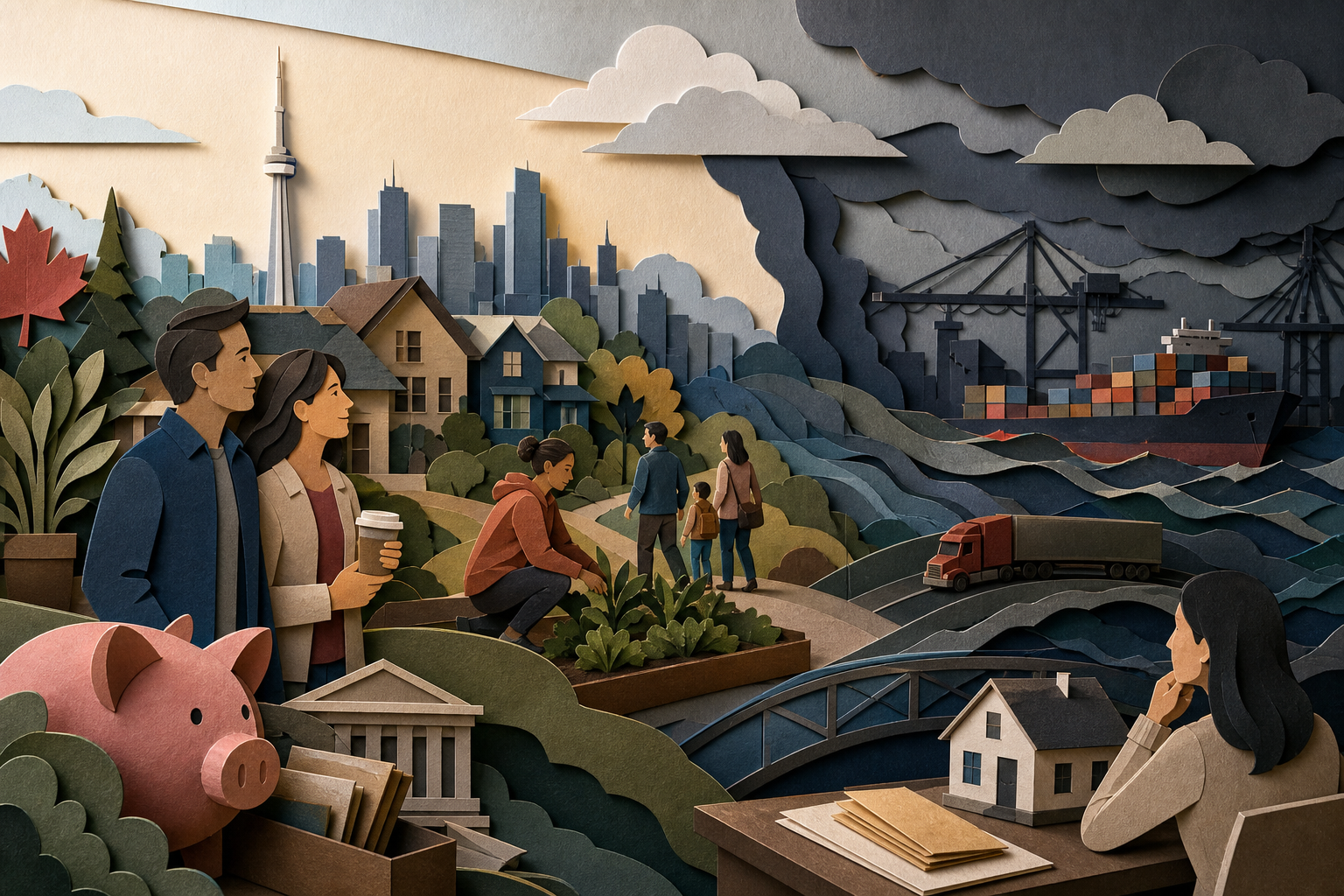
What's happening in Canadian sentiment right now is textbook decoupling. Households feel better. The data underneath suggests they probably shouldn't.
Why Optimism Is Climbing
Two shifts have done most of the work. Gasoline prices in the Greater Toronto Area averaged $1.42 per litre in May, down from $1.68 the previous summer. That drop shows up immediately in how people answer polls about their financial outlook. The second shift is subtler: trade war headlines no longer move the needle. The same polling that tracks sentiment also tracks "headline attention," and the correlation between trade friction stories and negative outlook broke in Q1 2026. Canadians stopped treating tariff announcements as economic emergencies. They started treating them as background noise.
Housing stabilization matters more than either of those. Mortgage rates for five-year fixed terms plateaued around 5.2% after two years of climbing. That plateau, not a drop, just a plateau, has been enough to convince homeowners that the bottom isn't falling out. For a country where 68% of households own their primary residence and where housing wealth drives most middle-class net worth, that psychological floor is structural. When the asset that represents your largest holding stops looking fragile, your general outlook improves even if your paycheque hasn't.
Where the Numbers Diverge
Household debt-to-disposable-income ratios sat at 181% as of Q1 2026, roughly where they've been since late 2023. That's the second-highest in the G7. The only reason delinquency rates haven't spiked is that unemployment has stayed low, 5.8% nationally, and variable-rate mortgage holders who renewed into higher payments had enough income cushion to absorb the shock. The cushion isn't infinite.
Corporate investment tells a different story than consumer confidence. Non-residential business investment as a percentage of GDP has been flat to declining since mid-2024. Firms aren't betting on growth. They're waiting. The optimism showing up in consumer polls isn't showing up in capital expenditure plans, which means businesses see something households don't, or households are ignoring something businesses can't.
Energy price stability, the thing propping up sentiment, is a lagging indicator dressed as a leading one. Global crude benchmarks have been range-bound for six months, but that range depends on OPEC production discipline holding and no major supply disruptions. Both of those are contingent, not structural. If either breaks, the "pain at the pump" factor that disappeared in early 2026 reappears fast, and sentiment follows it down.
What the Gap Means
The space between how people feel and what the numbers show isn't irrational. It's a timing mismatch. Sentiment responds to immediate, visible changes, gas prices, mortgage rate stability, the absence of new crises. Structural risks, debt loads, weak business investment, external trade vulnerabilities, take longer to materialize and longer to register emotionally.
Canadians aren't wrong to feel better. The economic weather improved. What hasn't improved is the foundation underneath it. Debt levels that were manageable at 5.8% unemployment become less manageable at 6.5%. Trade tensions that feel normalized now can still produce actual costs, they just haven't landed yet.
The polling captures a real shift in mood. The mood shift doesn't capture the risks still embedded in the system.



The Bank of Canada held its overnight rate steady at 4.25% in June 2026, citing "balanced risks" to the inflation outlook. Within three weeks, consumer confidence polling showed the sharpest single-month uptick since early 2022. The timing wasn't coincidence, it was psychological.
What's happening in Canadian sentiment right now is textbook decoupling. Households feel better. The data underneath suggests they probably shouldn't.
Why Optimism Is Climbing
Two shifts have done most of the work. Gasoline prices in the Greater Toronto Area averaged $1.42 per litre in May, down from $1.68 the previous summer. That drop shows up immediately in how people answer polls about their financial outlook. The second shift is subtler: trade war headlines no longer move the needle. The same polling that tracks sentiment also tracks "headline attention," and the correlation between trade friction stories and negative outlook broke in Q1 2026. Canadians stopped treating tariff announcements as economic emergencies. They started treating them as background noise.
Housing stabilization matters more than either of those. Mortgage rates for five-year fixed terms plateaued around 5.2% after two years of climbing. That plateau, not a drop, just a plateau, has been enough to convince homeowners that the bottom isn't falling out. For a country where 68% of households own their primary residence and where housing wealth drives most middle-class net worth, that psychological floor is structural. When the asset that represents your largest holding stops looking fragile, your general outlook improves even if your paycheque hasn't.
Where the Numbers Diverge
Household debt-to-disposable-income ratios sat at 181% as of Q1 2026, roughly where they've been since late 2023. That's the second-highest in the G7. The only reason delinquency rates haven't spiked is that unemployment has stayed low, 5.8% nationally, and variable-rate mortgage holders who renewed into higher payments had enough income cushion to absorb the shock. The cushion isn't infinite.
Corporate investment tells a different story than consumer confidence. Non-residential business investment as a percentage of GDP has been flat to declining since mid-2024. Firms aren't betting on growth. They're waiting. The optimism showing up in consumer polls isn't showing up in capital expenditure plans, which means businesses see something households don't, or households are ignoring something businesses can't.
Energy price stability, the thing propping up sentiment, is a lagging indicator dressed as a leading one. Global crude benchmarks have been range-bound for six months, but that range depends on OPEC production discipline holding and no major supply disruptions. Both of those are contingent, not structural. If either breaks, the "pain at the pump" factor that disappeared in early 2026 reappears fast, and sentiment follows it down.
What the Gap Means
The space between how people feel and what the numbers show isn't irrational. It's a timing mismatch. Sentiment responds to immediate, visible changes, gas prices, mortgage rate stability, the absence of new crises. Structural risks, debt loads, weak business investment, external trade vulnerabilities, take longer to materialize and longer to register emotionally.
Canadians aren't wrong to feel better. The economic weather improved. What hasn't improved is the foundation underneath it. Debt levels that were manageable at 5.8% unemployment become less manageable at 6.5%. Trade tensions that feel normalized now can still produce actual costs, they just haven't landed yet.
The polling captures a real shift in mood. The mood shift doesn't capture the risks still embedded in the system.
Read Next
How Dual Citizens Can Claim RESP Tax Benefits Without Form 3520 Reporting
Bond Markets Are Pricing In Recovery, Not the 1970s Replay Already Underway
Why Fortress Tells Private Credit Lenders to Stop Chasing AI Data Centre Deals
Canada's Tax Code Punishes Work and Rewards Wealth Hoarding: Four Reforms That Would Actually Fix It