Every S&P 500 Sector Posts AI-Driven Earnings Growth for the First Time Since 2021
The last time every corner of the S&P 500 expanded simultaneously, the driver was stimulus checks and reopening euphoria. This time, the fuel is different: corporate spending on AI servers and data centers is no longer contained to the tech sector. It has leaked into utilities, industrials, real estate, and even consumer staples, reshaping profit margins in places the market barely watched a year ago.
The shift is structural. In 2023 and 2024, the earnings story was straightforward: Nvidia and a handful of hyperscalers spent billions on GPUs and data centers, and their stock prices reflected it. The rest of the market participated only as spectators. By late 2026, that concentration has unwound. Companies across all eleven S&P 500 sectors are now reporting earnings growth tied directly to AI deployment, marking the first broad-based expansion since the post-pandemic surge of 2021.
Why utilities became the silent winner
The most surprising beneficiary is the utilities sector, which has outperformed its ten-year average yield largely because AI model training requires staggering amounts of electricity. Data center power consumption is projected to grow at a compound annual rate near 14-16% through the end of the decade, according to 2026 estimates. Data centers are projected to consume 7.8% of U.S. electricity by 2030, up from 4% in 2025.
Utilities are no longer defensive portfolio ballast. They are the backbone of the AI build-out. Power substations and nuclear plants that sat dormant for years are back in active development, financed by long-term power purchase agreements with hyperscalers. The sector is seeing historic growth because data centers require staggering amounts of electricity, and the power grids that supply them have to be rebuilt at scale.
The deployment phase replaces the hardware phase
The market has moved through what analysts call the "hardware phase", the initial rush to buy GPUs and build server farms, and entered the "deployment phase," where businesses prove that AI tools generate measurable returns. Over 90% of S&P 500 companies mentioned "Artificial Intelligence" or "Generative AI" in their most recent quarterly earnings calls, a 2026 trend that reflects widespread adoption beyond experimental pilots.
The difference between mentioning AI and demonstrating line-item impact remains wide, but the gap is closing. Administrative and back-office functions are being automated at a pace that reduces labor costs without triggering mass layoffs. Instead, AI is managing labor shortages in specialized fields by taking over routine data processing. The productivity gains show up in margins, not headcount reductions.
Real estate is another quiet winner. Data centers require physical buildings, cooling systems, backup generators, and specialized construction. The industrial sector supplies the heavy machinery that makes those builds possible. What looks like a tech story on the surface is actually a supply chain event, rippling through sectors that don't typically move together.
The 2021 parallel and where it breaks down
The last time all sectors grew in tandem was during the reopening boom of 2021, driven by pent-up demand and fiscal stimulus. That growth was cyclical; it unwound as the money ran out. The current expansion is powered by capital expenditure that compounds over time rather than stimulus that burns off.
Aggregate earnings growth for the S&P 500 is projected to remain in the 32% for 2026 (as of September 2026 forecasts) for the 2026 fiscal year, buoyed by AI cost savings. That is happening despite a higher-for-longer interest rate environment, which historically would have constrained growth. The fact that margins are expanding anyway suggests the productivity thesis is holding.
But valuation risk is real. Many sectors are trading at historical premiums, which means much of the AI-fueled growth may already be priced in. Energy bottlenecks could also cap expansion. The U.S. electrical grid may not be able to scale fast enough to meet the power demands that AI data centers require. And regulatory drag, particularly around data privacy and antitrust in sensitive sectors like healthcare and finance, could dampen integration speed.
The broad-based nature of this cycle is real. Whether it sustains depends on whether the power grids and equipment can keep pace.


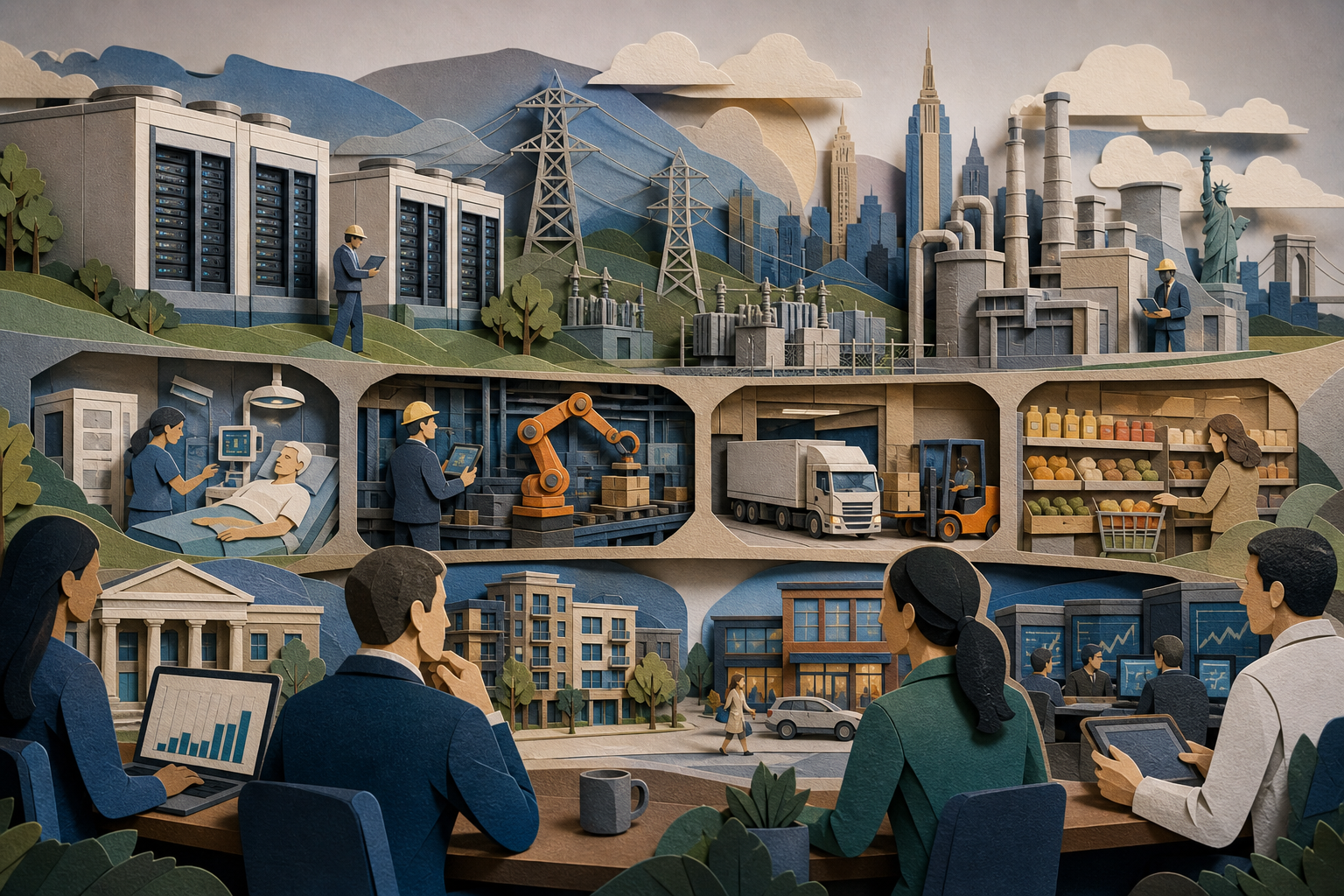

The last time every corner of the S&P 500 expanded simultaneously, the driver was stimulus checks and reopening euphoria. This time, the fuel is different: corporate spending on AI servers and data centers is no longer contained to the tech sector. It has leaked into utilities, industrials, real estate, and even consumer staples, reshaping profit margins in places the market barely watched a year ago.
The shift is structural. In 2023 and 2024, the earnings story was straightforward: Nvidia and a handful of hyperscalers spent billions on GPUs and data centers, and their stock prices reflected it. The rest of the market participated only as spectators. By late 2026, that concentration has unwound. Companies across all eleven S&P 500 sectors are now reporting earnings growth tied directly to AI deployment, marking the first broad-based expansion since the post-pandemic surge of 2021.
Why utilities became the silent winner
The most surprising beneficiary is the utilities sector, which has outperformed its ten-year average yield largely because AI model training requires staggering amounts of electricity. Data center power consumption is projected to grow at a compound annual rate near 14-16% through the end of the decade, according to 2026 estimates. Data centers are projected to consume 7.8% of U.S. electricity by 2030, up from 4% in 2025.
Utilities are no longer defensive portfolio ballast. They are the backbone of the AI build-out. Power substations and nuclear plants that sat dormant for years are back in active development, financed by long-term power purchase agreements with hyperscalers. The sector is seeing historic growth because data centers require staggering amounts of electricity, and the power grids that supply them have to be rebuilt at scale.
The deployment phase replaces the hardware phase
The market has moved through what analysts call the "hardware phase", the initial rush to buy GPUs and build server farms, and entered the "deployment phase," where businesses prove that AI tools generate measurable returns. Over 90% of S&P 500 companies mentioned "Artificial Intelligence" or "Generative AI" in their most recent quarterly earnings calls, a 2026 trend that reflects widespread adoption beyond experimental pilots.
The difference between mentioning AI and demonstrating line-item impact remains wide, but the gap is closing. Administrative and back-office functions are being automated at a pace that reduces labor costs without triggering mass layoffs. Instead, AI is managing labor shortages in specialized fields by taking over routine data processing. The productivity gains show up in margins, not headcount reductions.
Real estate is another quiet winner. Data centers require physical buildings, cooling systems, backup generators, and specialized construction. The industrial sector supplies the heavy machinery that makes those builds possible. What looks like a tech story on the surface is actually a supply chain event, rippling through sectors that don't typically move together.
The 2021 parallel and where it breaks down
The last time all sectors grew in tandem was during the reopening boom of 2021, driven by pent-up demand and fiscal stimulus. That growth was cyclical; it unwound as the money ran out. The current expansion is powered by capital expenditure that compounds over time rather than stimulus that burns off.
Aggregate earnings growth for the S&P 500 is projected to remain in the 32% for 2026 (as of September 2026 forecasts) for the 2026 fiscal year, buoyed by AI cost savings. That is happening despite a higher-for-longer interest rate environment, which historically would have constrained growth. The fact that margins are expanding anyway suggests the productivity thesis is holding.
But valuation risk is real. Many sectors are trading at historical premiums, which means much of the AI-fueled growth may already be priced in. Energy bottlenecks could also cap expansion. The U.S. electrical grid may not be able to scale fast enough to meet the power demands that AI data centers require. And regulatory drag, particularly around data privacy and antitrust in sensitive sectors like healthcare and finance, could dampen integration speed.
The broad-based nature of this cycle is real. Whether it sustains depends on whether the power grids and equipment can keep pace.
Sources
Read Next
How Dual Citizens Can Claim RESP Tax Benefits Without Form 3520 Reporting
Bond Markets Are Pricing In Recovery, Not the 1970s Replay Already Underway
Why Fortress Tells Private Credit Lenders to Stop Chasing AI Data Centre Deals
Canada's Tax Code Punishes Work and Rewards Wealth Hoarding: Four Reforms That Would Actually Fix It