How Trump's AI Border Tool Could Reshape the Rules of Tariff Enforcement
A shipment of lithium-ion batteries leaves a factory in Guangdong Province, passes through a Vietnamese warehouse for 48 hours, acquires new paperwork listing Hanoi as the origin, and arrives in Long Beach labeled "Made in Vietnam." The rerouting added six days and $200 per container. It also bypassed a 25% Section 301 tariff. Until recently, customs officers caught this maybe one time in fifty.
The Trump administration's solution is not more inspectors. It is machine learning applied to the entire paper trail, bills of lading, satellite imagery of the "Vietnamese" factory, energy consumption records that show the facility runs two shifts instead of twenty, corporate ownership filings that trace the manufacturer back to Shenzhen. The system flags the shipment before it clears the port. The importer now has to prove the batteries were actually made in Vietnam, not just boxed there.
This is the structural shift. Tariff enforcement historically worked like retail loss prevention: you catch some theft, price in the rest, and accept that the system leaks. The new model is predictive. Customs and Border Protection is moving from sampling manifest data to analyzing billions of data points in real time, looking for patterns that correlate with country-of-origin fraud. The AI is not trying to find every fraudulent shipment. It is trying to make fraud expensive enough that the economics of transshipment stop working.
The Compliance Data Arms Race
The system creates a new burden that falls unevenly. A multinational with an in-house trade compliance team can produce granular supply chain data, part numbers, factory certifications, raw material sourcing documents, at the speed the algorithm demands. A small importer working with a freight forwarder in Guadalajara cannot. The result is that algorithmic enforcement consolidates power among large players who can afford the compliance infrastructure, while smaller operators face shipment holds they lack the resources to resolve quickly.
The tells the system looks for are becoming more sophisticated. Early transshipment was crude: Chinese-origin steel would arrive in Mexico, get stamped with a new label, and ship north. Now the model examines whether the "Mexican" producer is consuming enough electricity to actually melt and roll steel, or whether it is just operating a warehouse. It cross-references corporate registries to see if the factory is owned by a Chinese parent. When Vietnam's steel exports to the U.S. tripled in 2025 while its domestic steel capacity rose only 11%, the algorithm flagged the gap. U.S. trade officials presented the data to Hanoi and threatened secondary tariffs unless Vietnam tightened its own export controls.
That pattern is repeating across USMCA and other agreements. The AI creates leverage. The U.S. can show a trading partner a dataset that says, "These fifty factories you certified as legitimate producers are statistically unlikely to be making anything." The partner government then faces a choice: audit those factories and cut off the fraudulent exporters, or lose preferential access to U.S. markets. This is trade enforcement as compelled transparency.
What Breaks When the System Works
False positives are the predictable cost. A legitimate Vietnamese manufacturer that sources some components from China but performs substantial transformation in Hanoi can still get flagged if the component share crosses an algorithmic threshold the system does not publish. The importer's shipment sits in a bonded warehouse while they produce documentation the model will accept. Even when cleared, the delay has cost them the Just-In-Time delivery window their contract required.
The deeper issue is adversarial adaptation. The same machine learning techniques that power the "detective border" can be used to spoof it. If the system prioritizes energy consumption data, a transshipment operation runs machinery at partial load to generate the consumption signature of a real factory. If it checks corporate ownership, shell companies proliferate. Trade fraud has always been a cat-and-mouse game. AI just makes both sides faster.
The administration's goal is not perfection. It is raising the cost of evasion high enough that reshoring or nearshoring to compliant suppliers becomes the cheaper option. Whether that accelerates U.S. manufacturing or just pushes prices higher depends on whether domestic capacity can actually absorb the demand. The 2026 data will answer that.


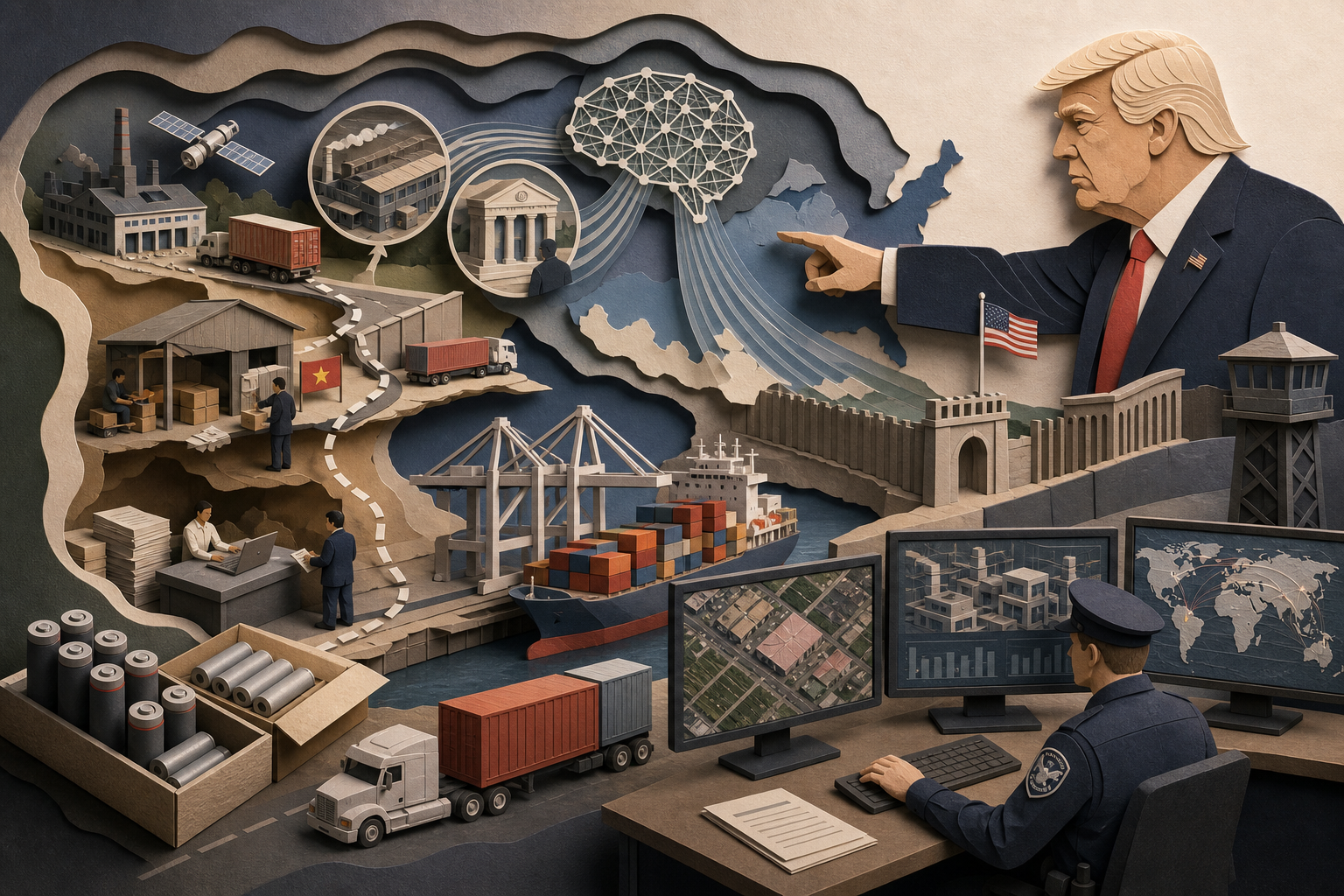

A shipment of lithium-ion batteries leaves a factory in Guangdong Province, passes through a Vietnamese warehouse for 48 hours, acquires new paperwork listing Hanoi as the origin, and arrives in Long Beach labeled "Made in Vietnam." The rerouting added six days and $200 per container. It also bypassed a 25% Section 301 tariff. Until recently, customs officers caught this maybe one time in fifty.
The Trump administration's solution is not more inspectors. It is machine learning applied to the entire paper trail, bills of lading, satellite imagery of the "Vietnamese" factory, energy consumption records that show the facility runs two shifts instead of twenty, corporate ownership filings that trace the manufacturer back to Shenzhen. The system flags the shipment before it clears the port. The importer now has to prove the batteries were actually made in Vietnam, not just boxed there.
This is the structural shift. Tariff enforcement historically worked like retail loss prevention: you catch some theft, price in the rest, and accept that the system leaks. The new model is predictive. Customs and Border Protection is moving from sampling manifest data to analyzing billions of data points in real time, looking for patterns that correlate with country-of-origin fraud. The AI is not trying to find every fraudulent shipment. It is trying to make fraud expensive enough that the economics of transshipment stop working.
The Compliance Data Arms Race
The system creates a new burden that falls unevenly. A multinational with an in-house trade compliance team can produce granular supply chain data, part numbers, factory certifications, raw material sourcing documents, at the speed the algorithm demands. A small importer working with a freight forwarder in Guadalajara cannot. The result is that algorithmic enforcement consolidates power among large players who can afford the compliance infrastructure, while smaller operators face shipment holds they lack the resources to resolve quickly.
The tells the system looks for are becoming more sophisticated. Early transshipment was crude: Chinese-origin steel would arrive in Mexico, get stamped with a new label, and ship north. Now the model examines whether the "Mexican" producer is consuming enough electricity to actually melt and roll steel, or whether it is just operating a warehouse. It cross-references corporate registries to see if the factory is owned by a Chinese parent. When Vietnam's steel exports to the U.S. tripled in 2025 while its domestic steel capacity rose only 11%, the algorithm flagged the gap. U.S. trade officials presented the data to Hanoi and threatened secondary tariffs unless Vietnam tightened its own export controls.
That pattern is repeating across USMCA and other agreements. The AI creates leverage. The U.S. can show a trading partner a dataset that says, "These fifty factories you certified as legitimate producers are statistically unlikely to be making anything." The partner government then faces a choice: audit those factories and cut off the fraudulent exporters, or lose preferential access to U.S. markets. This is trade enforcement as compelled transparency.
What Breaks When the System Works
False positives are the predictable cost. A legitimate Vietnamese manufacturer that sources some components from China but performs substantial transformation in Hanoi can still get flagged if the component share crosses an algorithmic threshold the system does not publish. The importer's shipment sits in a bonded warehouse while they produce documentation the model will accept. Even when cleared, the delay has cost them the Just-In-Time delivery window their contract required.
The deeper issue is adversarial adaptation. The same machine learning techniques that power the "detective border" can be used to spoof it. If the system prioritizes energy consumption data, a transshipment operation runs machinery at partial load to generate the consumption signature of a real factory. If it checks corporate ownership, shell companies proliferate. Trade fraud has always been a cat-and-mouse game. AI just makes both sides faster.
The administration's goal is not perfection. It is raising the cost of evasion high enough that reshoring or nearshoring to compliant suppliers becomes the cheaper option. Whether that accelerates U.S. manufacturing or just pushes prices higher depends on whether domestic capacity can actually absorb the demand. The 2026 data will answer that.
Read Next
How Dual Citizens Can Claim RESP Tax Benefits Without Form 3520 Reporting
Bond Markets Are Pricing In Recovery, Not the 1970s Replay Already Underway
Why Fortress Tells Private Credit Lenders to Stop Chasing AI Data Centre Deals
Canada's Tax Code Punishes Work and Rewards Wealth Hoarding: Four Reforms That Would Actually Fix It