Hudson's Bay closures force landlords to rethink anchor strategy, not just replacement tenants
When a 135,000-square-foot anchor box goes dark, the problem isn't finding a new tenant. It's that the business case that justified the box no longer exists.
Hudson's Bay operated under a model where shoppers arrived intending to browse multiple departments, park for two hours, and leave with bags from apparel, home goods, and beauty. That trip is extinct. The shopper who wants athletic wear goes to Lululemon. The one upgrading kitchen items orders from Amazon. The one replacing makeup drives to Sephora. No single replacement tenant wants the entire footprint because no single retailer serves the "everything under one roof" customer anymore, that customer doesn't come to the mall.
Landlords holding these vacancies aren't asking "Who can lease this space?" They're asking "What is this space even for?"
The arithmetic working against backfill
Retrofitting a department store into smaller units isn't cosmetic. The boxes were designed as anchors, meaning minimal street frontage, multi-level layouts built for escalators, and structural systems that assume one tenant controls the entire shell. Bringing that space to market as 8 to 12 separate storefronts requires new demising walls, updated HVAC per suite, exterior entries where none existed, and often elevator or fire-code work to meet current standards for multi-tenant buildings.
CBRE Canada pegs those conversions at $20 million to $50 million depending on the site. Suburban malls, where Bay locations averaged closer to 600,000 square feet in flagship formats, sit at the high end. The capital outlay only makes sense if the resulting rent roll justifies it, and in secondary markets, it often doesn't. A Bay paying $12 per square foot on a legacy lease might get carved into ten tenants each paying $35, but only if those ten tenants exist and want that location. In a Class B mall two hours outside Toronto, they don't.
Covenants make the math worse
Older anchor leases often contain co-tenancy clauses allowing other mall tenants to pay reduced rent or terminate early if a named anchor like Hudson's Bay stays vacant beyond a set threshold, typically 6 to 12 months. Once triggered, those clauses can cut effective rent across the entire center by 15 to 25 percent while the landlord burns capital on a conversion with no committed backfill. The result is a downward spiral: falling revenue, deferred maintenance, further tenant flight.
For REITs that co-owned Bay locations through joint ventures, a common structure in Canadian retail, they're now part-owners of the vacancy threatening their own asset values. The conflict is structural. Filling the space fast favours stability. Holding out for the right mix favours long-term performance. The mortgage and the tax roll don't wait for strategy.
What's actually replacing the boxes
The viable plays split along urban versus suburban lines. In downtown Toronto, Vancouver, or Montreal, a vacant Bay becomes a residential podium. The 750,000-square-foot Queen Street location is worth more as 400 condos than as retail. Zoning approvals take three to seven years, but the land value underwrites the wait.
In suburban centers, the anchor box is being broken outward. Landlords are "de-malling", removing interior mall corridors, reorienting storefronts to face parking lots, and creating open-air formats where the old Bay becomes five street-facing tenants and two pad sites. Grocery performs. Medical clinics perform. Gyms and entertainment perform. Department stores sit empty.
In secondary markets, vacant big-boxes become last-mile fulfillment centers for e-commerce. Municipalities resist because the zoning laws allow them to attract foot traffic and sales tax through retail, but resist the truck bays and loading docks and warehouse staff that come with logistics. When the landlord can't land residential approvals or convince a grocer to anchor, the logistics tenant starts looking like the only tenant.
What none of this resembles is replacing one anchor with another. The anchor model itself died. The Bay closures simply made it impossible to pretend otherwise.


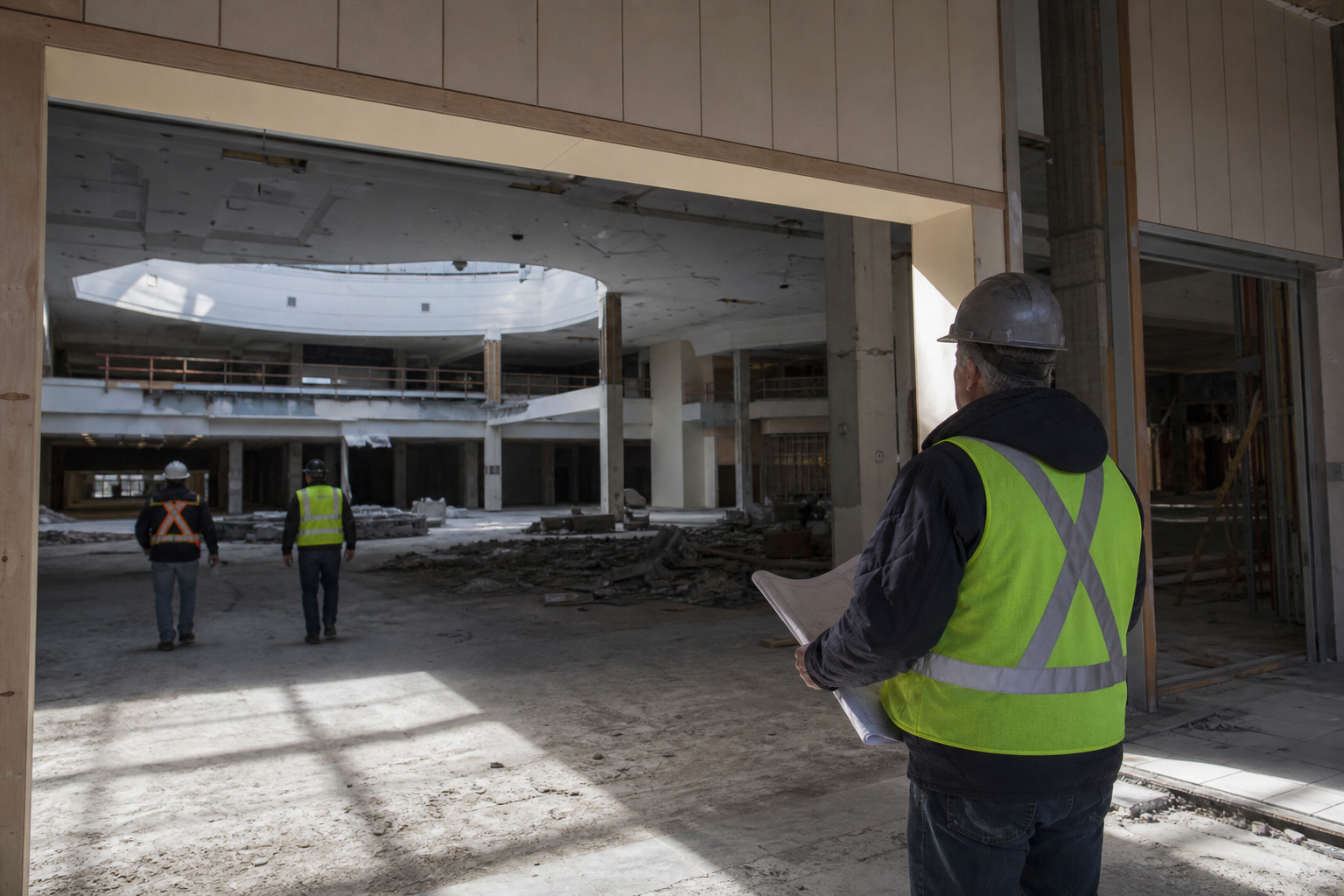

When a 135,000-square-foot anchor box goes dark, the problem isn't finding a new tenant. It's that the business case that justified the box no longer exists.
Hudson's Bay operated under a model where shoppers arrived intending to browse multiple departments, park for two hours, and leave with bags from apparel, home goods, and beauty. That trip is extinct. The shopper who wants athletic wear goes to Lululemon. The one upgrading kitchen items orders from Amazon. The one replacing makeup drives to Sephora. No single replacement tenant wants the entire footprint because no single retailer serves the "everything under one roof" customer anymore, that customer doesn't come to the mall.
Landlords holding these vacancies aren't asking "Who can lease this space?" They're asking "What is this space even for?"
The arithmetic working against backfill
Retrofitting a department store into smaller units isn't cosmetic. The boxes were designed as anchors, meaning minimal street frontage, multi-level layouts built for escalators, and structural systems that assume one tenant controls the entire shell. Bringing that space to market as 8 to 12 separate storefronts requires new demising walls, updated HVAC per suite, exterior entries where none existed, and often elevator or fire-code work to meet current standards for multi-tenant buildings.
CBRE Canada pegs those conversions at $20 million to $50 million depending on the site. Suburban malls, where Bay locations averaged closer to 600,000 square feet in flagship formats, sit at the high end. The capital outlay only makes sense if the resulting rent roll justifies it, and in secondary markets, it often doesn't. A Bay paying $12 per square foot on a legacy lease might get carved into ten tenants each paying $35, but only if those ten tenants exist and want that location. In a Class B mall two hours outside Toronto, they don't.
Covenants make the math worse
Older anchor leases often contain co-tenancy clauses allowing other mall tenants to pay reduced rent or terminate early if a named anchor like Hudson's Bay stays vacant beyond a set threshold, typically 6 to 12 months. Once triggered, those clauses can cut effective rent across the entire center by 15 to 25 percent while the landlord burns capital on a conversion with no committed backfill. The result is a downward spiral: falling revenue, deferred maintenance, further tenant flight.
For REITs that co-owned Bay locations through joint ventures, a common structure in Canadian retail, they're now part-owners of the vacancy threatening their own asset values. The conflict is structural. Filling the space fast favours stability. Holding out for the right mix favours long-term performance. The mortgage and the tax roll don't wait for strategy.
What's actually replacing the boxes
The viable plays split along urban versus suburban lines. In downtown Toronto, Vancouver, or Montreal, a vacant Bay becomes a residential podium. The 750,000-square-foot Queen Street location is worth more as 400 condos than as retail. Zoning approvals take three to seven years, but the land value underwrites the wait.
In suburban centers, the anchor box is being broken outward. Landlords are "de-malling", removing interior mall corridors, reorienting storefronts to face parking lots, and creating open-air formats where the old Bay becomes five street-facing tenants and two pad sites. Grocery performs. Medical clinics perform. Gyms and entertainment perform. Department stores sit empty.
In secondary markets, vacant big-boxes become last-mile fulfillment centers for e-commerce. Municipalities resist because the zoning laws allow them to attract foot traffic and sales tax through retail, but resist the truck bays and loading docks and warehouse staff that come with logistics. When the landlord can't land residential approvals or convince a grocer to anchor, the logistics tenant starts looking like the only tenant.
What none of this resembles is replacing one anchor with another. The anchor model itself died. The Bay closures simply made it impossible to pretend otherwise.
Sources
Read Next
How Dual Citizens Can Claim RESP Tax Benefits Without Form 3520 Reporting
Bond Markets Are Pricing In Recovery, Not the 1970s Replay Already Underway
Why Fortress Tells Private Credit Lenders to Stop Chasing AI Data Centre Deals
Canada's Tax Code Punishes Work and Rewards Wealth Hoarding: Four Reforms That Would Actually Fix It