Laneway homes cost $200,000 to $400,000, here's when the math actually works
Nicole Grayson paid $380,000 to build an 850-square-foot laneway house behind her Toronto semi-detached in 2023. The monthly rent at $2,800 covers her property tax increase and throws off about $1,100 in net income after utilities and maintenance reserves. By the standard break-even math, she's looking at a 22-year payback on construction cost from rental income alone. That math is real, but it's also the wrong frame for most people thinking about these projects.
The decision to build a laneway home isn't binary. It splits into four distinct use cases, each with a different financial structure. Understanding which one you're in determines whether the $200,000 to $400,000 price tag (the realistic range in most Canadian cities as of mid-2026, with Toronto and Vancouver builds routinely hitting $450,000 to $550,000 for premium finishes) makes sense or locks you into a decade-long sunk cost.
The Four Use Cases
Case 1: Pure rental income. You own a property in a high-demand urban area. You have the capital or can access low-cost financing. You intend to rent the laneway house at market rates to a third party for the foreseeable future. The unit will be treated like an investment property, managed professionally or semi-professionally, and held long enough that the upfront cost amortizes across rental cash flows and property value appreciation.
Case 2: Multi-generational living. An aging parent moves into the laneway house, or adult children take the main house while you downsize to the laneway. The financial benefit is indirect: avoided long-term care costs, avoided rent for an adult child who would otherwise lease elsewhere, or the ability to defer selling a larger family home during a market downturn. No rental income, but measurable cost avoidance.
Case 3: Short-term rental arbitrage. You build the laneway house and list it on Airbnb or similar platforms in a jurisdiction where short-term rentals remain legally viable. Revenue is higher per night than long-term rent, but occupancy is variable and regulatory risk is rising fast. Toronto effectively banned most short-term rentals in 2024; Vancouver has tightened enforcement. Calgary and Ottawa still allow them under specific licensing rules, but momentum is moving the other direction.
Case 4: Future optionality with no immediate use. You build it now because zoning or federal loan access is favorable, planning to use it later for aging parents, rental income, or resale value lift. This is speculative. You're betting that land densification will increase your property's marketability when you eventually sell, or that having the infrastructure in place saves you from higher construction costs five or ten years out.
The math works cleanly only in Case 1 and, under narrow conditions, Case 3. The other two rely on cost avoidance or future value that is hard to model with precision.
Case 1 Math: Rental Income Path
Start with Nicole's scenario but add the variables that change the outcome.
She borrowed $380,000 at 5.8% over 15 years (a standard HELOC rate in mid-2026 for homeowners with significant equity). Monthly loan payment: $3,150. Rental income after property management, utilities, insurance delta, and a maintenance reserve: $2,100. She's running a monthly deficit of $1,050, or $12,600 per year.
Why do it? Two reasons. First, the loan is secured against a property she already owns and has no intention of selling. The $12,600 annual shortfall is offset by mortgage principal paydown on the construction loan (about $17,000 in year one) and the property value increase from adding a legal second dwelling. In Toronto's current market, appraisers are valuing laneway-equipped properties at 60% to 75% of the construction cost added to base property value. On a $380,000 build, that's $228,000 to $285,000 in equity lift. Not cash, but real balance-sheet value if she refinances or sells.
Second reason: the rental income grows. Market rent in her neighborhood has been rising roughly 4% per year since 2021. By year five, that $2,800 rent is closer to $3,400. Her loan payment stays flat. The deficit narrows, then flips to surplus around year eight. From that point forward, it's net positive cash flow on an asset she owns outright by year 15.
Where it stops working: if rental vacancy exceeds 10% annually, if property values stagnate or decline (removing the equity-lift component), or if interest rates were higher. At 7.5%, her monthly payment would be $3,520, widening the deficit to $1,420 per month. That's $17,000 per year in negative carry, and the rental growth has to be stronger and more consistent to overcome it.
The boundary case: if you cannot finance below 6.5%, or if your local rental market has vacancy rates above 8%, the pure rental path requires either higher upfront equity (reducing the loan) or a longer hold period before it turns positive. For most owner-occupiers in Vancouver, Toronto, and Ottawa with stable long-term plans and access to sub-6% financing, Case 1 works. For speculative builds in softer markets or with expensive borrowed money, it doesn't.
Case 2 Math: Multi-Generational Cost Avoidance
David Kim in Burnaby built a 650-square-foot laneway house in 2025 for $310,000. His mother moved in. No rent collected. The financial justification: private long-term care in metro Vancouver runs $4,500 to $7,000 per month depending on care level. His mother doesn't need full-time care yet, but she was previously renting a one-bedroom at $2,200 per month.
By moving her into the laneway house, David avoids $2,200 per month in ongoing rent she was paying elsewhere (which, as family support, often fell partially on him). That's $26,400 per year. At that rate, the construction cost is "recovered" in avoided rent over roughly 12 years. If his mother eventually needs care and stays in the laneway house with part-time support instead of moving to a facility, the avoided cost jumps to $4,500+ per month, collapsing the payback to under six years.
This works only if the alternative cost is real and unavoidable. If his mother owned her previous home and sold it to fund the laneway build, the math changes entirely, now the laneway house is just a different allocation of capital she already had, and there's no true cost avoidance.
Case 3 and Case 4: The Narrow and The Speculative
Case 3 (short-term rentals) can generate $4,000 to $6,000 per month gross in high-tourism markets, but occupancy averages 60% to 75%, regulation is tightening, and platform fees and cleaning costs eat 25% to 35% of gross revenue. After expenses, it often nets similarly to long-term rent, with far more operational burden and regulatory risk. Unless you are in a jurisdiction with explicit, stable short-term rental licensing and you have experience managing turnover, treat this as a higher-risk version of Case 1.
Case 4 is speculation. You're paying today's construction cost to create an asset you might use or monetize later. If construction costs keep rising (they have, averaging 6% to 8% annually in major Canadian metros since 2021), locking in today's price could save money. But you're also paying financing costs or opportunity cost on dead capital for years before any return materializes. This makes sense only if you have specific near-term plans (aging parent who will need the space within 24 months, adult child finishing school in two years) or if you are convinced your property will not sell at target price without the density already in place.
The Unpriced Variables
Three costs consistently underestimated: permit and development charges (routinely $25,000 to $50,000 in Toronto, less in smaller municipalities but never trivial), utility upgrades to support an independent dwelling (new electrical panel, water/sewer lateral connections, gas line extensions, often $15,000 to $30,000), and site access constraints. If your laneway is narrow or your lot has mature trees, expect builders to quote 10% to 20% above base per-square-foot rates due to logistics.
The federal Secondary Suite Loan (CMHC's $40,000 low-interest offering launched in 2024) helps, but it is a loan, not a grant. It lowers your effective borrowing cost but does not reduce the nominal capital requirement.
The rule: laneway homes work financially when rental income or cost avoidance is guaranteed, measurable, and durable for at least a decade. If you are building for optionality or appreciation, you are making a real estate bet, not executing a cash-flow plan. Know which one you're doing before the builder breaks ground.


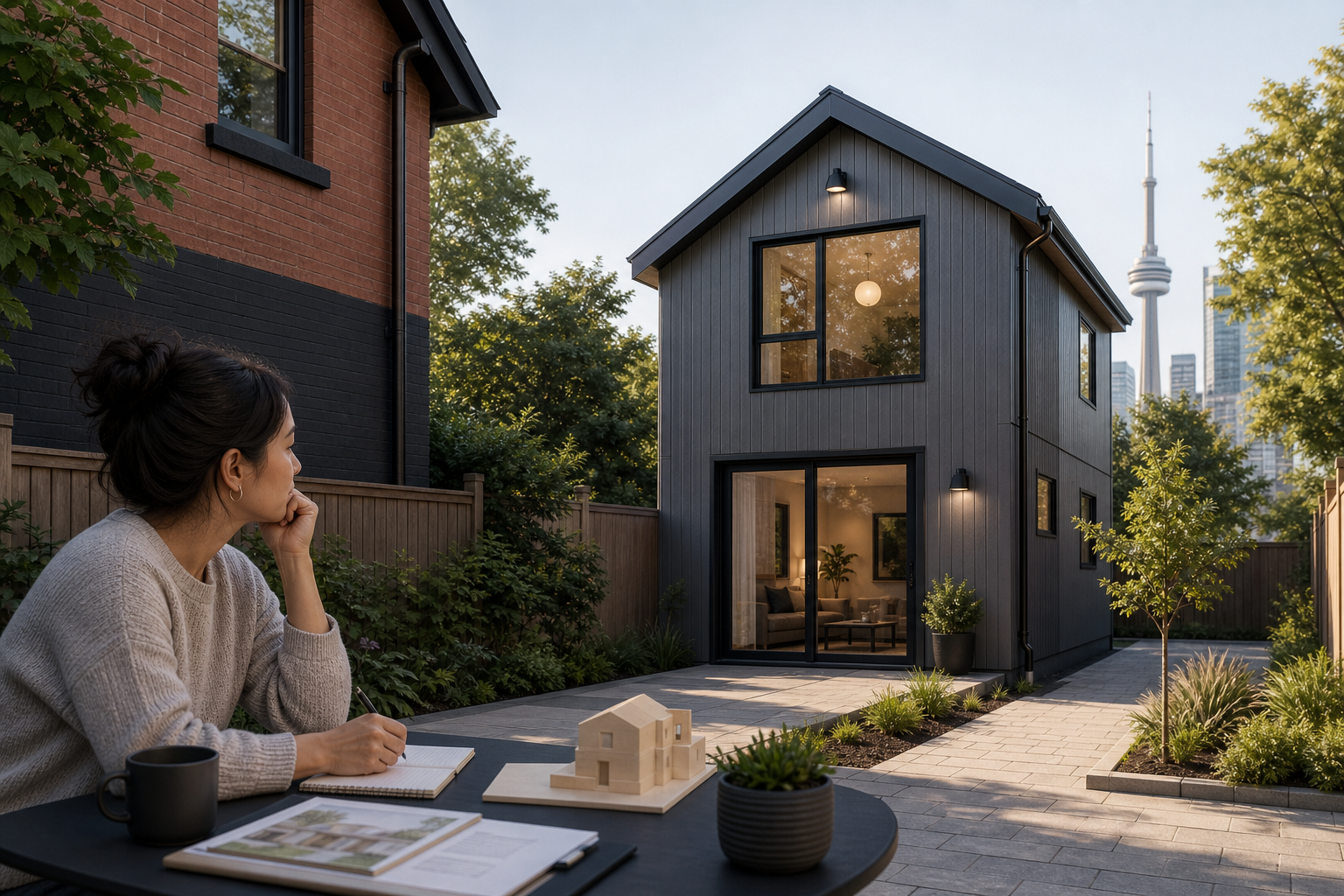

Nicole Grayson paid $380,000 to build an 850-square-foot laneway house behind her Toronto semi-detached in 2023. The monthly rent at $2,800 covers her property tax increase and throws off about $1,100 in net income after utilities and maintenance reserves. By the standard break-even math, she's looking at a 22-year payback on construction cost from rental income alone. That math is real, but it's also the wrong frame for most people thinking about these projects.
The decision to build a laneway home isn't binary. It splits into four distinct use cases, each with a different financial structure. Understanding which one you're in determines whether the $200,000 to $400,000 price tag (the realistic range in most Canadian cities as of mid-2026, with Toronto and Vancouver builds routinely hitting $450,000 to $550,000 for premium finishes) makes sense or locks you into a decade-long sunk cost.
The Four Use Cases
Case 1: Pure rental income. You own a property in a high-demand urban area. You have the capital or can access low-cost financing. You intend to rent the laneway house at market rates to a third party for the foreseeable future. The unit will be treated like an investment property, managed professionally or semi-professionally, and held long enough that the upfront cost amortizes across rental cash flows and property value appreciation.
Case 2: Multi-generational living. An aging parent moves into the laneway house, or adult children take the main house while you downsize to the laneway. The financial benefit is indirect: avoided long-term care costs, avoided rent for an adult child who would otherwise lease elsewhere, or the ability to defer selling a larger family home during a market downturn. No rental income, but measurable cost avoidance.
Case 3: Short-term rental arbitrage. You build the laneway house and list it on Airbnb or similar platforms in a jurisdiction where short-term rentals remain legally viable. Revenue is higher per night than long-term rent, but occupancy is variable and regulatory risk is rising fast. Toronto effectively banned most short-term rentals in 2024; Vancouver has tightened enforcement. Calgary and Ottawa still allow them under specific licensing rules, but momentum is moving the other direction.
Case 4: Future optionality with no immediate use. You build it now because zoning or federal loan access is favorable, planning to use it later for aging parents, rental income, or resale value lift. This is speculative. You're betting that land densification will increase your property's marketability when you eventually sell, or that having the infrastructure in place saves you from higher construction costs five or ten years out.
The math works cleanly only in Case 1 and, under narrow conditions, Case 3. The other two rely on cost avoidance or future value that is hard to model with precision.
Case 1 Math: Rental Income Path
Start with Nicole's scenario but add the variables that change the outcome.
She borrowed $380,000 at 5.8% over 15 years (a standard HELOC rate in mid-2026 for homeowners with significant equity). Monthly loan payment: $3,150. Rental income after property management, utilities, insurance delta, and a maintenance reserve: $2,100. She's running a monthly deficit of $1,050, or $12,600 per year.
Why do it? Two reasons. First, the loan is secured against a property she already owns and has no intention of selling. The $12,600 annual shortfall is offset by mortgage principal paydown on the construction loan (about $17,000 in year one) and the property value increase from adding a legal second dwelling. In Toronto's current market, appraisers are valuing laneway-equipped properties at 60% to 75% of the construction cost added to base property value. On a $380,000 build, that's $228,000 to $285,000 in equity lift. Not cash, but real balance-sheet value if she refinances or sells.
Second reason: the rental income grows. Market rent in her neighborhood has been rising roughly 4% per year since 2021. By year five, that $2,800 rent is closer to $3,400. Her loan payment stays flat. The deficit narrows, then flips to surplus around year eight. From that point forward, it's net positive cash flow on an asset she owns outright by year 15.
Where it stops working: if rental vacancy exceeds 10% annually, if property values stagnate or decline (removing the equity-lift component), or if interest rates were higher. At 7.5%, her monthly payment would be $3,520, widening the deficit to $1,420 per month. That's $17,000 per year in negative carry, and the rental growth has to be stronger and more consistent to overcome it.
The boundary case: if you cannot finance below 6.5%, or if your local rental market has vacancy rates above 8%, the pure rental path requires either higher upfront equity (reducing the loan) or a longer hold period before it turns positive. For most owner-occupiers in Vancouver, Toronto, and Ottawa with stable long-term plans and access to sub-6% financing, Case 1 works. For speculative builds in softer markets or with expensive borrowed money, it doesn't.
Case 2 Math: Multi-Generational Cost Avoidance
David Kim in Burnaby built a 650-square-foot laneway house in 2025 for $310,000. His mother moved in. No rent collected. The financial justification: private long-term care in metro Vancouver runs $4,500 to $7,000 per month depending on care level. His mother doesn't need full-time care yet, but she was previously renting a one-bedroom at $2,200 per month.
By moving her into the laneway house, David avoids $2,200 per month in ongoing rent she was paying elsewhere (which, as family support, often fell partially on him). That's $26,400 per year. At that rate, the construction cost is "recovered" in avoided rent over roughly 12 years. If his mother eventually needs care and stays in the laneway house with part-time support instead of moving to a facility, the avoided cost jumps to $4,500+ per month, collapsing the payback to under six years.
This works only if the alternative cost is real and unavoidable. If his mother owned her previous home and sold it to fund the laneway build, the math changes entirely, now the laneway house is just a different allocation of capital she already had, and there's no true cost avoidance.
Case 3 and Case 4: The Narrow and The Speculative
Case 3 (short-term rentals) can generate $4,000 to $6,000 per month gross in high-tourism markets, but occupancy averages 60% to 75%, regulation is tightening, and platform fees and cleaning costs eat 25% to 35% of gross revenue. After expenses, it often nets similarly to long-term rent, with far more operational burden and regulatory risk. Unless you are in a jurisdiction with explicit, stable short-term rental licensing and you have experience managing turnover, treat this as a higher-risk version of Case 1.
Case 4 is speculation. You're paying today's construction cost to create an asset you might use or monetize later. If construction costs keep rising (they have, averaging 6% to 8% annually in major Canadian metros since 2021), locking in today's price could save money. But you're also paying financing costs or opportunity cost on dead capital for years before any return materializes. This makes sense only if you have specific near-term plans (aging parent who will need the space within 24 months, adult child finishing school in two years) or if you are convinced your property will not sell at target price without the density already in place.
The Unpriced Variables
Three costs consistently underestimated: permit and development charges (routinely $25,000 to $50,000 in Toronto, less in smaller municipalities but never trivial), utility upgrades to support an independent dwelling (new electrical panel, water/sewer lateral connections, gas line extensions, often $15,000 to $30,000), and site access constraints. If your laneway is narrow or your lot has mature trees, expect builders to quote 10% to 20% above base per-square-foot rates due to logistics.
The federal Secondary Suite Loan (CMHC's $40,000 low-interest offering launched in 2024) helps, but it is a loan, not a grant. It lowers your effective borrowing cost but does not reduce the nominal capital requirement.
The rule: laneway homes work financially when rental income or cost avoidance is guaranteed, measurable, and durable for at least a decade. If you are building for optionality or appreciation, you are making a real estate bet, not executing a cash-flow plan. Know which one you're doing before the builder breaks ground.
Read Next
How Dual Citizens Can Claim RESP Tax Benefits Without Form 3520 Reporting
Bond Markets Are Pricing In Recovery, Not the 1970s Replay Already Underway
Why Fortress Tells Private Credit Lenders to Stop Chasing AI Data Centre Deals
Canada's Tax Code Punishes Work and Rewards Wealth Hoarding: Four Reforms That Would Actually Fix It