Ten Straight Quarters of 'Affordability Gains' Ignore What Really Keeps Buyers Out
A mortgage now eats 51.1% of median household income in Canada. That's down from a peak of 62.5% in late 2023, but nobody's throwing a parade.
National Bank of Canada just announced the tenth consecutive quarter of affordability improvements, the longest sustained recovery period in recent records. The headline writers love it. The politicians cite it. The real estate industry pins it to press releases. And it's all true in the same way that "fewer people are drowning" is true after you drain three feet of water from the deep end of the pool.
The affordability metric everybody tracks, mortgage payment as a share of income, has improved because home prices fell, not because Canadians suddenly got richer. Wages barely moved. The national housing stock saw a staggered price correction from its 2022 peak, interest rates stabilized after their 2023 spike, and the arithmetic improved. That's the whole story. We are celebrating our way back to "merely unaffordable" from "mathematically impossible."
The 51% Problem Nobody Mentions
The long-term historical average for mortgage payments sits around 40.6% of median income. We are still 10 percentage points above that, which doesn't sound dramatic until you convert it to real money. On a median household income of around $78,000, that extra 10 points is $7,800 a year, $650 a month, in excess shelter cost compared to what used to be normal. That's the gap between "tight but manageable" and "one furnace replacement away from trouble."
The improvement streak also hides a structural problem the ratio can't measure: the down payment trap. Even as monthly carrying costs edge toward sanity, the upfront cash required to enter the market remains near record highs. A 20% down payment on a $600,000 home in mid-2026 is $120,000. Saving that sum while paying rent that tracks to market rates takes the median Canadian household roughly eight to ten years, assuming zero disruptions and perfect discipline. The affordability ratio treats that barrier as if it doesn't exist.
Regional Math That Doesn't Add Up
The national average is also doing heavy lifting. Markets in the Prairies and Atlantic Canada have seen modest price declines and were never as detached from incomes to begin with. Vancouver and Toronto, where the majority of population growth is concentrated, remain in a different universe. A median earner in either city is not "10% away from affordability", they are structurally priced out without external capital or dual high incomes. The ten-quarter streak in those markets is decorative.
Then there's the stress test. The Office of the Superintendent of Financial Institutions requires buyers to qualify at a rate 200 basis points above their contract rate, or 5.25%, whichever is higher. A household might be able to carry a mortgage at today's rates, but they can't pass the qualification threshold. The affordability metric measures what they could theoretically handle. The stress test measures what they can actually access. The gap between those two numbers is where most first-time buyers are stuck.
What Ten Quarters of Gains Actually Bought
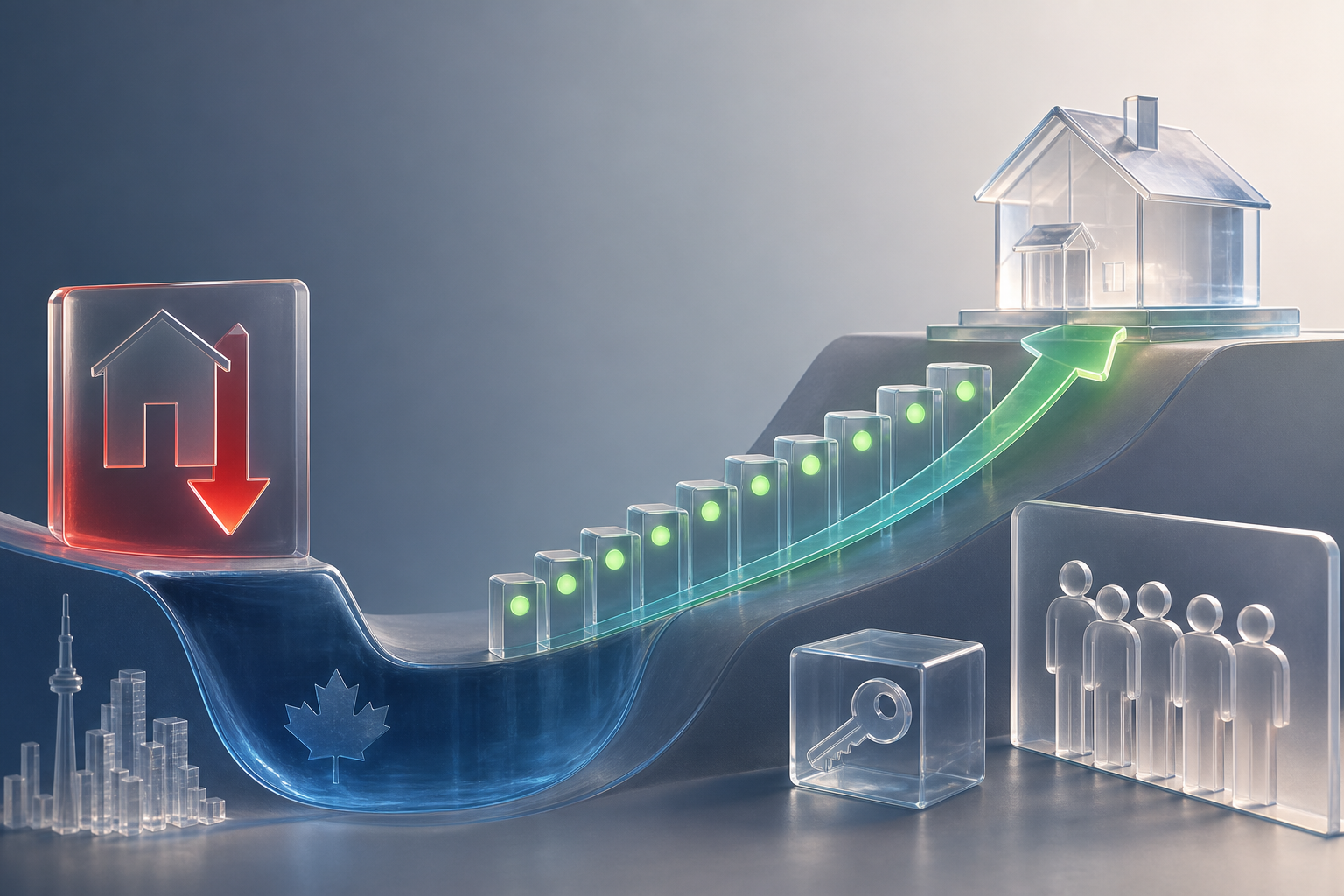
The correction has done something useful: it has moved the national conversation from "this is unsolvable" to "this is solvable but we're not solving it." That shift matters. But framing the current moment as a recovery obscures how far we still are from a functional housing market. We are climbing out of a valley. We are not yet at the trailhead.
Affordability gains driven by falling asset prices are fragile. If prices bottom and start rising again while wage growth stays flat, the improvement reverses instantly. The ten-quarter streak will look, in hindsight, like a brief correction inside a long-term crisis. The ratio improved. The structure didn't.



A mortgage now eats 51.1% of median household income in Canada. That's down from a peak of 62.5% in late 2023, but nobody's throwing a parade.
National Bank of Canada just announced the tenth consecutive quarter of affordability improvements, the longest sustained recovery period in recent records. The headline writers love it. The politicians cite it. The real estate industry pins it to press releases. And it's all true in the same way that "fewer people are drowning" is true after you drain three feet of water from the deep end of the pool.
The affordability metric everybody tracks, mortgage payment as a share of income, has improved because home prices fell, not because Canadians suddenly got richer. Wages barely moved. The national housing stock saw a staggered price correction from its 2022 peak, interest rates stabilized after their 2023 spike, and the arithmetic improved. That's the whole story. We are celebrating our way back to "merely unaffordable" from "mathematically impossible."
The 51% Problem Nobody Mentions
The long-term historical average for mortgage payments sits around 40.6% of median income. We are still 10 percentage points above that, which doesn't sound dramatic until you convert it to real money. On a median household income of around $78,000, that extra 10 points is $7,800 a year, $650 a month, in excess shelter cost compared to what used to be normal. That's the gap between "tight but manageable" and "one furnace replacement away from trouble."
The improvement streak also hides a structural problem the ratio can't measure: the down payment trap. Even as monthly carrying costs edge toward sanity, the upfront cash required to enter the market remains near record highs. A 20% down payment on a $600,000 home in mid-2026 is $120,000. Saving that sum while paying rent that tracks to market rates takes the median Canadian household roughly eight to ten years, assuming zero disruptions and perfect discipline. The affordability ratio treats that barrier as if it doesn't exist.
Regional Math That Doesn't Add Up
The national average is also doing heavy lifting. Markets in the Prairies and Atlantic Canada have seen modest price declines and were never as detached from incomes to begin with. Vancouver and Toronto, where the majority of population growth is concentrated, remain in a different universe. A median earner in either city is not "10% away from affordability", they are structurally priced out without external capital or dual high incomes. The ten-quarter streak in those markets is decorative.
Then there's the stress test. The Office of the Superintendent of Financial Institutions requires buyers to qualify at a rate 200 basis points above their contract rate, or 5.25%, whichever is higher. A household might be able to carry a mortgage at today's rates, but they can't pass the qualification threshold. The affordability metric measures what they could theoretically handle. The stress test measures what they can actually access. The gap between those two numbers is where most first-time buyers are stuck.
What Ten Quarters of Gains Actually Bought
The correction has done something useful: it has moved the national conversation from "this is unsolvable" to "this is solvable but we're not solving it." That shift matters. But framing the current moment as a recovery obscures how far we still are from a functional housing market. We are climbing out of a valley. We are not yet at the trailhead.
Affordability gains driven by falling asset prices are fragile. If prices bottom and start rising again while wage growth stays flat, the improvement reverses instantly. The ten-quarter streak will look, in hindsight, like a brief correction inside a long-term crisis. The ratio improved. The structure didn't.
Sources
Read Next
How Dual Citizens Can Claim RESP Tax Benefits Without Form 3520 Reporting
Bond Markets Are Pricing In Recovery, Not the 1970s Replay Already Underway
Why Fortress Tells Private Credit Lenders to Stop Chasing AI Data Centre Deals
Canada's Tax Code Punishes Work and Rewards Wealth Hoarding: Four Reforms That Would Actually Fix It