Toronto Penthouses Sell in 17 Days While Condos Below Sit for Months
A 47-year-old surgeon sells a Rosedale estate for $8.3 million and moves into a Yorkville penthouse two weeks later. The unit, 3,400 square feet across one floor with its own elevator entry, spent seventeen days on the market. That same week, a 680-square-foot one-bedroom three blocks away hit its ninetieth day of active listing with no offers.
Sales of Toronto homes priced above $10 million climbed roughly 200% year-over-year through the recent reporting period, while overall condo inventory in the Greater Toronto Area swelled past 8,000 active listings. The divergence is structural, not cyclical. These are no longer two segments of the same market behaving differently in the same downturn. They are operating under separate economic rules.
What the $10M+ Buyer Actually Wants
The penthouse buyer is not a typical condo buyer moving up. Most are downsizers leaving large detached homes who want the maintenance convenience of a condo without sacrificing square footage or privacy. They are looking for what the industry now calls "vertical estates", units that function as single-family homes in the sky.
That means 3,000+ square feet, private elevator access, and service levels that mirror what they had in Forest Hill or the Bridle Path. The amenity expectation has shifted beyond gyms and pools to 24/7 concierge, car-detailing bays, private wine storage, and in some cases dedicated staff elevators so residents never share a ride with maintenance workers. These are not conveniences. They are the price of entry.
Yorkville remains the centre of gravity for this segment, where price per square foot can reach $4,000 or higher for turnkey units. Rosedale and the Forest Hill corridor pull a similar buyer profile, often the same individuals rotating between detached properties and penthouses depending on life stage.
Why Standard Condos Are Stalling
The 1-bedroom and 2-bedroom units sitting unsold for months were largely purchased by investors during the low-rate period. When rates climbed, the math stopped working. Investors who bought pre-construction expecting to flip or rent at a profit are now holding units they cannot carry and cannot sell without taking a loss.
The result is inventory that doesn't clear. Buyers waiting for desperate sellers have time on their side, so transactions slow further. In this segment, thirty to forty-five days on market is now normal. Anything under three weeks signals either aggressive pricing or a rare desirable unit in a building with very low fees.
The $10M+ segment has almost no leverage in the capital structure. Most buyers use cash or minimal financing. Interest rate changes affect their broader portfolios but not the specific decision to buy a penthouse. They are also making a different risk calculation, not yield, not appreciation, but preservation. Toronto real estate at the top end is being treated as a safe-haven asset in a volatile economy.
The Supply Problem That Won't Resolve
Thousands of shoebox condos are under construction across the GTA. The supply of architecturally distinct, low-density luxury penthouses is functionally capped. Developers are now shifting toward boutique projects with fewer units and higher service models, but these take years to deliver and the pipeline is thin.
That creates permanent scarcity at the top. A penthouse in a well-run Yorkville building is competing with maybe a dozen comparable units across the city, not the hundreds of fungible 1-bedrooms flooding the market below.
The 200% jump in $10M+ sales reflects a small absolute number of transactions, dozens, not thousands, but the velocity matters. These units are moving faster than they did two years ago, while everything below them has slowed. The gap is widening, and nothing in the current supply or rate environment suggests it will narrow.


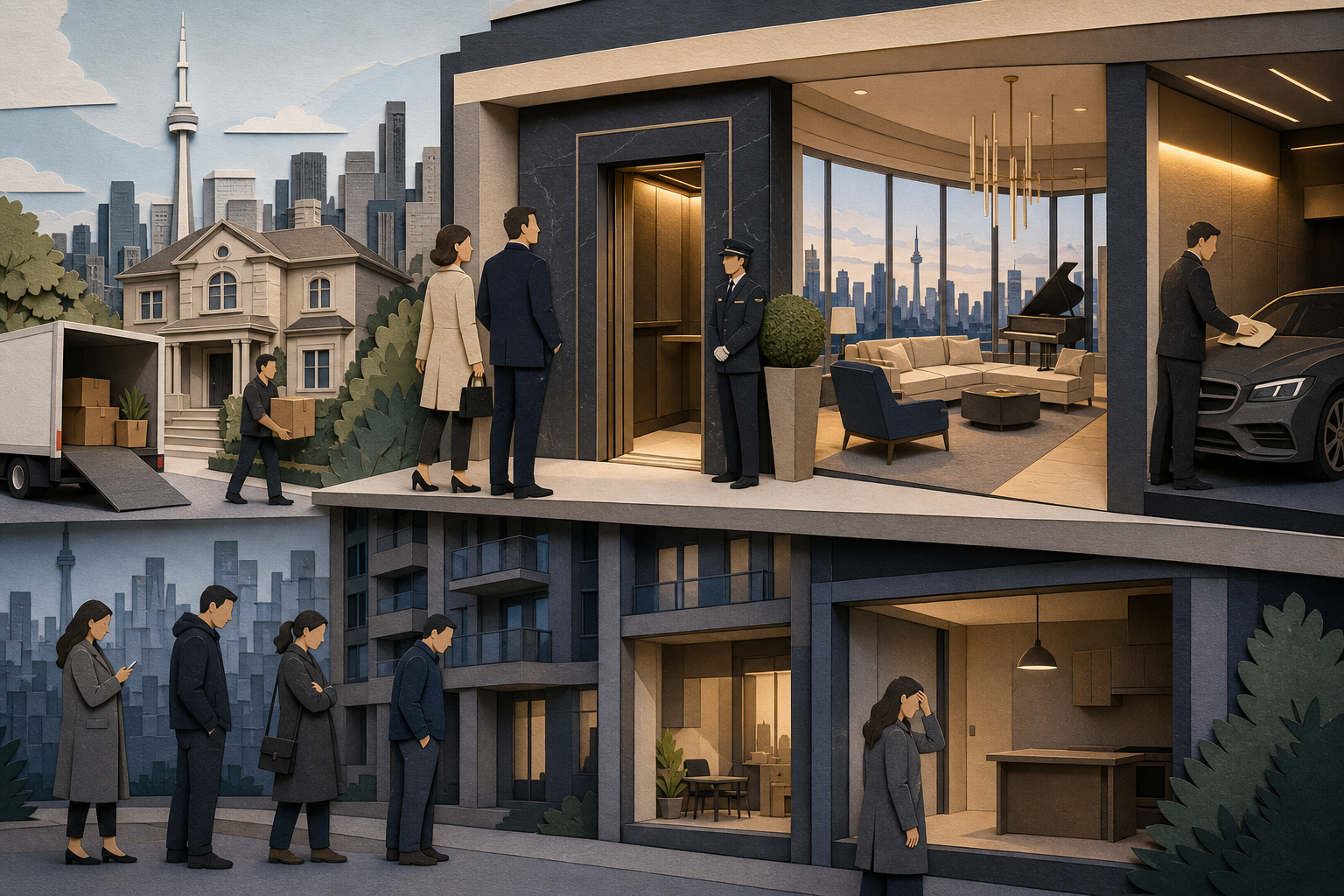

A 47-year-old surgeon sells a Rosedale estate for $8.3 million and moves into a Yorkville penthouse two weeks later. The unit, 3,400 square feet across one floor with its own elevator entry, spent seventeen days on the market. That same week, a 680-square-foot one-bedroom three blocks away hit its ninetieth day of active listing with no offers.
Sales of Toronto homes priced above $10 million climbed roughly 200% year-over-year through the recent reporting period, while overall condo inventory in the Greater Toronto Area swelled past 8,000 active listings. The divergence is structural, not cyclical. These are no longer two segments of the same market behaving differently in the same downturn. They are operating under separate economic rules.
What the $10M+ Buyer Actually Wants
The penthouse buyer is not a typical condo buyer moving up. Most are downsizers leaving large detached homes who want the maintenance convenience of a condo without sacrificing square footage or privacy. They are looking for what the industry now calls "vertical estates", units that function as single-family homes in the sky.
That means 3,000+ square feet, private elevator access, and service levels that mirror what they had in Forest Hill or the Bridle Path. The amenity expectation has shifted beyond gyms and pools to 24/7 concierge, car-detailing bays, private wine storage, and in some cases dedicated staff elevators so residents never share a ride with maintenance workers. These are not conveniences. They are the price of entry.
Yorkville remains the centre of gravity for this segment, where price per square foot can reach $4,000 or higher for turnkey units. Rosedale and the Forest Hill corridor pull a similar buyer profile, often the same individuals rotating between detached properties and penthouses depending on life stage.
Why Standard Condos Are Stalling
The 1-bedroom and 2-bedroom units sitting unsold for months were largely purchased by investors during the low-rate period. When rates climbed, the math stopped working. Investors who bought pre-construction expecting to flip or rent at a profit are now holding units they cannot carry and cannot sell without taking a loss.
The result is inventory that doesn't clear. Buyers waiting for desperate sellers have time on their side, so transactions slow further. In this segment, thirty to forty-five days on market is now normal. Anything under three weeks signals either aggressive pricing or a rare desirable unit in a building with very low fees.
The $10M+ segment has almost no leverage in the capital structure. Most buyers use cash or minimal financing. Interest rate changes affect their broader portfolios but not the specific decision to buy a penthouse. They are also making a different risk calculation, not yield, not appreciation, but preservation. Toronto real estate at the top end is being treated as a safe-haven asset in a volatile economy.
The Supply Problem That Won't Resolve
Thousands of shoebox condos are under construction across the GTA. The supply of architecturally distinct, low-density luxury penthouses is functionally capped. Developers are now shifting toward boutique projects with fewer units and higher service models, but these take years to deliver and the pipeline is thin.
That creates permanent scarcity at the top. A penthouse in a well-run Yorkville building is competing with maybe a dozen comparable units across the city, not the hundreds of fungible 1-bedrooms flooding the market below.
The 200% jump in $10M+ sales reflects a small absolute number of transactions, dozens, not thousands, but the velocity matters. These units are moving faster than they did two years ago, while everything below them has slowed. The gap is widening, and nothing in the current supply or rate environment suggests it will narrow.
Read Next
How Dual Citizens Can Claim RESP Tax Benefits Without Form 3520 Reporting
Bond Markets Are Pricing In Recovery, Not the 1970s Replay Already Underway
Why Fortress Tells Private Credit Lenders to Stop Chasing AI Data Centre Deals
Canada's Tax Code Punishes Work and Rewards Wealth Hoarding: Four Reforms That Would Actually Fix It