Trump Sells Tariffs in Michigan as Gordie Howe Bridge Opens Under Trade War Shadow
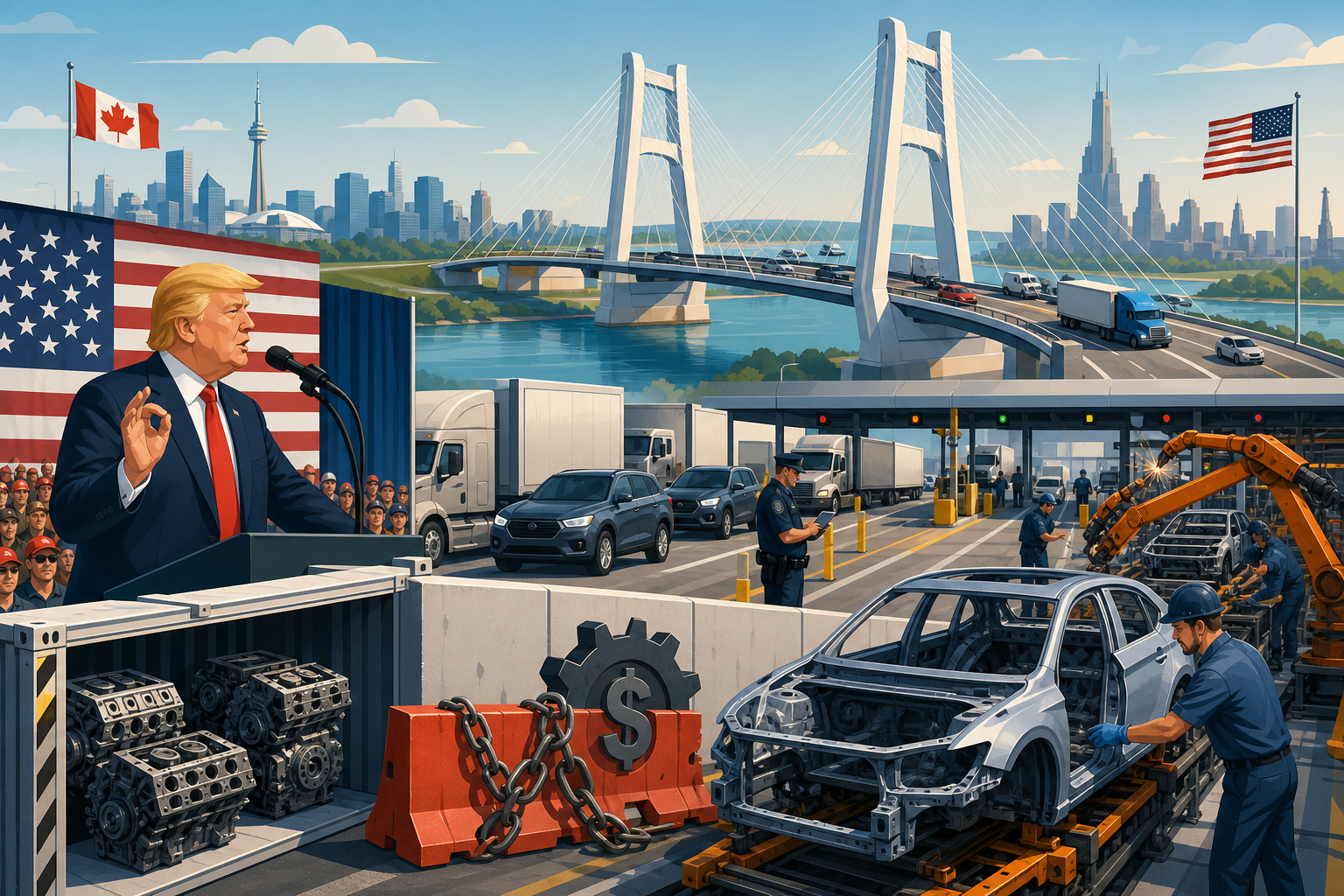
The $6.4-billion Gordie Howe International Bridge opened last week with speeches about partnership, efficiency, and the future of cross-border commerce. By the time the ceremonial ribbon was cut, the U.S. administration had already announced a 25% baseline tariff on Canadian imports slated for 2026. The bridge is designed to handle more trade. The tariff is designed to block it.
Trump's appearance in Michigan this week wasn't about the bridge. It was about selling protectionism to a state whose economy depends on the thing protectionism breaks: integration. Michigan and Ontario don't just trade with each other, they manufacture together. A vehicle crosses the Detroit-Windsor corridor up to seven times during production before final assembly. The Ambassador Bridge and the new Gordie Howe crossing exist because that back-and-forth movement is the entire point of the North American auto sector. You can't tariff your way to onshoring when the thing being built is already half-built on both sides.
The political logic is simple. Tariffs poll well in the Rust Belt. They sound like sovereignty, like jobs coming home, like correcting decades of bad deals. The economic logic is harder. Over $100 billion in trade moves through the Detroit-Windsor corridor annually. That's not widgets shipped in one direction, it's an actual supply chain where Michigan-made parts go to Ontario for one stage of assembly, then come back for another. A 25% tariff doesn't just raise the price of a finished Canadian car. It raises the cost at every cross, compounding each time the same part moves.
The Leverage Argument Falls Apart at the Border
The administration's position is that tariff threats force concessions: higher Canadian defense spending, better dairy market access, stricter immigration enforcement. That works if the threat is targeted and temporary. It doesn't work when the threat becomes policy and the target is the integrated supply chain your own state depends on.
Michigan's automakers are not abstract victims of trade policy, they are direct participants in a system where Canadian steel, aluminum, and parts are American inputs. The same applies to energy. Canada supplies more crude oil to the U.S. than any other country, and the electrical grid in the Great Lakes region is interconnected at the operational level. A blanket tariff on Canadian electricity is a tax on Michigan industry that happens to be collected in Windsor.
While Ottawa and Washington Clash, the Governors Talk
The real counterweight to the tariff push isn't happening at the federal level. It's happening between Ontario Premier Doug Ford and governors in the Great Lakes states, who understand that the economics don't care about the talking points. When Ford meets with Michigan's governor, the conversation isn't about nationalism, it's about keeping the lights on and the assembly lines moving.
This is the same pattern that emerged during the first Trump administration, when NAFTA renegotiation theater played out in Washington while the actual trade relationships were defended by mayors, chambers of commerce, and state-level officials who had to live with the consequences. The Gordie Howe Bridge was funded, planned, and built by people who believed the corridor mattered more than the politics. The tariff policy is being written by people who believe the opposite.
The bridge can move goods faster. It cannot move them cheaper if every crossing gets taxed at 25%. The infrastructure works. The policy breaks it. That's not a paradox, it's just what happens when you build cooperation and tax it at the same time.



The $6.4-billion Gordie Howe International Bridge opened last week with speeches about partnership, efficiency, and the future of cross-border commerce. By the time the ceremonial ribbon was cut, the U.S. administration had already announced a 25% baseline tariff on Canadian imports slated for 2026. The bridge is designed to handle more trade. The tariff is designed to block it.
Trump's appearance in Michigan this week wasn't about the bridge. It was about selling protectionism to a state whose economy depends on the thing protectionism breaks: integration. Michigan and Ontario don't just trade with each other, they manufacture together. A vehicle crosses the Detroit-Windsor corridor up to seven times during production before final assembly. The Ambassador Bridge and the new Gordie Howe crossing exist because that back-and-forth movement is the entire point of the North American auto sector. You can't tariff your way to onshoring when the thing being built is already half-built on both sides.
The political logic is simple. Tariffs poll well in the Rust Belt. They sound like sovereignty, like jobs coming home, like correcting decades of bad deals. The economic logic is harder. Over $100 billion in trade moves through the Detroit-Windsor corridor annually. That's not widgets shipped in one direction, it's an actual supply chain where Michigan-made parts go to Ontario for one stage of assembly, then come back for another. A 25% tariff doesn't just raise the price of a finished Canadian car. It raises the cost at every cross, compounding each time the same part moves.
The Leverage Argument Falls Apart at the Border
The administration's position is that tariff threats force concessions: higher Canadian defense spending, better dairy market access, stricter immigration enforcement. That works if the threat is targeted and temporary. It doesn't work when the threat becomes policy and the target is the integrated supply chain your own state depends on.
Michigan's automakers are not abstract victims of trade policy, they are direct participants in a system where Canadian steel, aluminum, and parts are American inputs. The same applies to energy. Canada supplies more crude oil to the U.S. than any other country, and the electrical grid in the Great Lakes region is interconnected at the operational level. A blanket tariff on Canadian electricity is a tax on Michigan industry that happens to be collected in Windsor.
While Ottawa and Washington Clash, the Governors Talk
The real counterweight to the tariff push isn't happening at the federal level. It's happening between Ontario Premier Doug Ford and governors in the Great Lakes states, who understand that the economics don't care about the talking points. When Ford meets with Michigan's governor, the conversation isn't about nationalism, it's about keeping the lights on and the assembly lines moving.
This is the same pattern that emerged during the first Trump administration, when NAFTA renegotiation theater played out in Washington while the actual trade relationships were defended by mayors, chambers of commerce, and state-level officials who had to live with the consequences. The Gordie Howe Bridge was funded, planned, and built by people who believed the corridor mattered more than the politics. The tariff policy is being written by people who believe the opposite.
The bridge can move goods faster. It cannot move them cheaper if every crossing gets taxed at 25%. The infrastructure works. The policy breaks it. That's not a paradox, it's just what happens when you build cooperation and tax it at the same time.
Read Next
How Dual Citizens Can Claim RESP Tax Benefits Without Form 3520 Reporting
Bond Markets Are Pricing In Recovery, Not the 1970s Replay Already Underway
Why Fortress Tells Private Credit Lenders to Stop Chasing AI Data Centre Deals
Canada's Tax Code Punishes Work and Rewards Wealth Hoarding: Four Reforms That Would Actually Fix It