A client walked into a broker's office last month with $120,000 saved for a down payment on a $600,000 home. Twenty percent exactly. She'd spent eighteen months hitting that number because every personal finance book written before 2020 told her it was the goal. Then the broker showed her two scenarios. Fifteen percent down: 3.69%. Twenty percent down: 3.95%. The rate went up when the down payment went up. She thought it was a typo.
It wasn't.
The insurance subsidy no one calls a subsidy
In Canada, any mortgage with less than 20% down is legally required to carry default insurance from CMHC, Sagen, or Canada Guaranty. The insurance protects the lender, not you. If you default, the insurer pays the lender and comes after you for the balance. You pay a one-time premium, 4.0% of the loan amount at 5% down, 2.8% at 15% down, and that cost gets rolled into your mortgage balance.
That's the part everyone hates. The part nobody explains: the insurance moves the mortgage from a risk asset to a zero-risk asset on the lender's balance sheet. Under OSFI rules, banks hold almost no capital against insured mortgages because they cannot lose money on them. An uninsured mortgage, even at 20% down, stays on the risk side of the ledger. The lender carries the full downside if the market drops 15% and you walk away. They charge you for that exposure.
The rate difference runs 20 to 30 basis points, typically. On a $510,000 loan (15% down on $600,000), that's $950 less per year in interest at 3.69% versus 3.95%. Over five years, you save $4,750 in interest payments before the first renewal. The insurance premium at 15% down is $14,280. You pay more upfront, but the lower rate starts clawing it back immediately.
The dead zone at exactly 20%
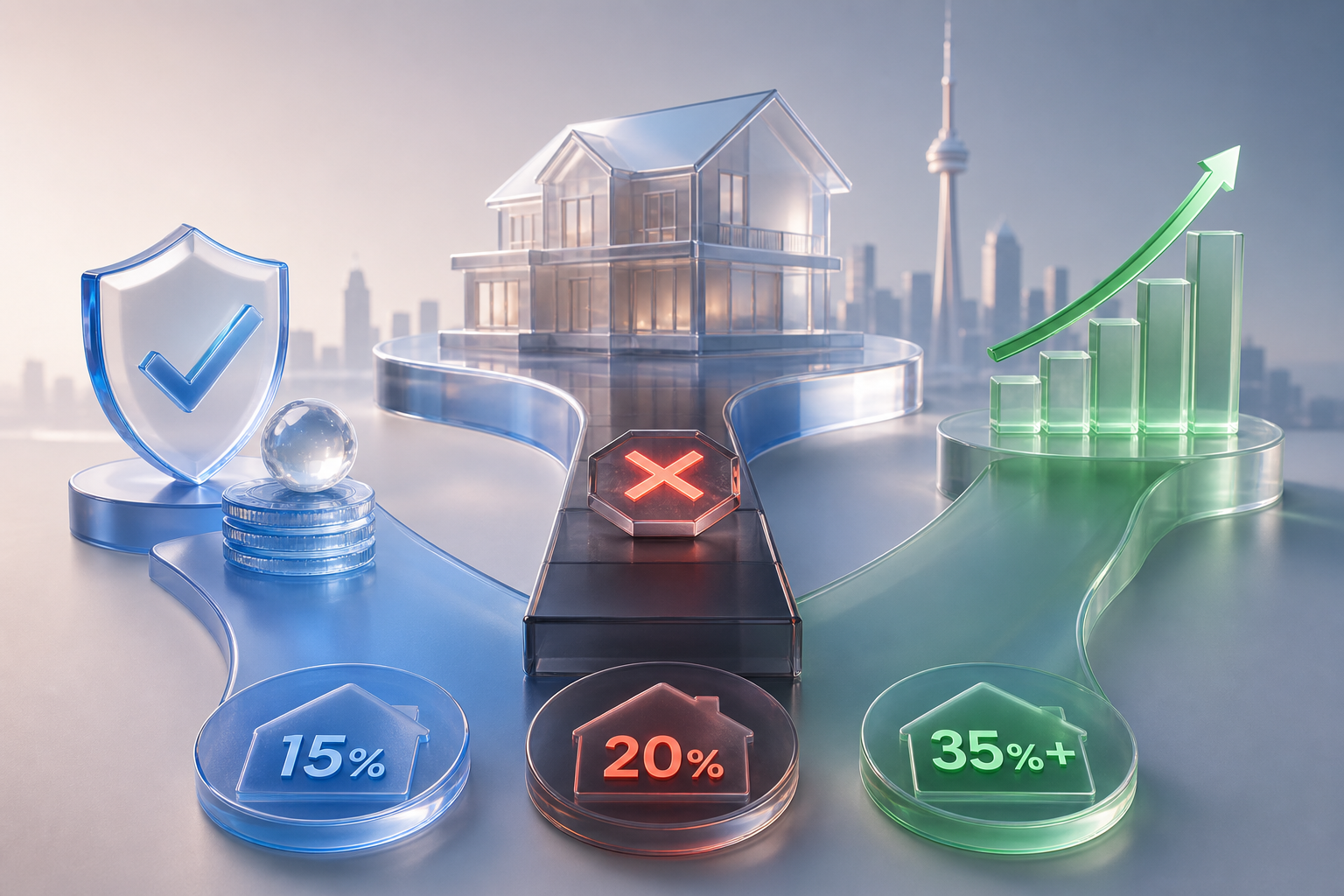
The math gets worse at the threshold. Put down 19% and you get the insured rate. Put down 20% and you lose it, but you don't have enough equity to unlock the deep discounts some lenders offer at 35% or 40% down. You land in the middle: no insurance backing, no equity leverage, full lender risk pricing.
A borrower who can afford 20% down is often better off putting 15% down, taking the lower rate, and deploying the other 5% somewhere it compounds faster than 3.69%. If you're carrying credit card debt at 21%, the spread is obvious. If you have RRSP contribution room and a marginal tax rate above 40%, the refund math tilts hard. Even a modest non-registered portfolio returning 6% annualized beats the opportunity cost of locking that capital into home equity earning the after-tax equivalent of your mortgage rate.
The psychological block is real. Mortgage insurance feels like a penalty for not having saved enough. Rationally, it's a tool for buying a lower interest rate from the bank with a one-time fee instead of five years of higher monthly payments.
The amortization offset
Uninsured mortgages can stretch to 30 years. Insured mortgages cap at 25. Even with a higher rate, a 30-year uninsured loan can produce a lower monthly payment than a 25-year insured one, which matters if cash flow is tight. But cash flow and total cost are different problems. The 30-year loan costs more over its life. The question is whether the extra liquidity today is worth the interest penalty later.
For someone expecting income growth, a 29-year-old pharmacist two years into practice, a trades apprentice finishing their ticket, the 25-year insured loan at the lower rate usually wins. For someone with flat income and high monthly obligations, the 30-year option buys breathing room even if the rate stings.
Properties over $1 million
None of this applies above the $1 million threshold. Mortgage default insurance is unavailable on properties priced at $1 million or higher, regardless of down payment. At that tier, everyone is uninsured, and the rate negotiation becomes a function of credit profile, income documentation, and lender appetite. The paradox disappears because the subsidy was never available.
The inverted pricing structure only exists in the band where insurance is both required and permitted: properties under $1 million, down payments between 5% and 19.99%. Outside that range, the assumptions revert. More equity usually means better terms, because the lender isn't getting a third-party guarantee to zero out the risk.
For the client with $120,000 saved, the broker ran the full cost comparison. Fifteen percent down, 3.69%, 25-year amortization, total interest over five years: $89,420. Twenty percent down, 3.95%, 25-year amortization, total interest: $94,170. The insurance premium added $14,280 to the principal, but the rate savings covered a third of it in the first term. She put down $90,000 and kept $30,000 liquid. The system rewards the opposite of what the conventional advice promises.



A client walked into a broker's office last month with $120,000 saved for a down payment on a $600,000 home. Twenty percent exactly. She'd spent eighteen months hitting that number because every personal finance book written before 2020 told her it was the goal. Then the broker showed her two scenarios. Fifteen percent down: 3.69%. Twenty percent down: 3.95%. The rate went up when the down payment went up. She thought it was a typo.
It wasn't.
The insurance subsidy no one calls a subsidy
In Canada, any mortgage with less than 20% down is legally required to carry default insurance from CMHC, Sagen, or Canada Guaranty. The insurance protects the lender, not you. If you default, the insurer pays the lender and comes after you for the balance. You pay a one-time premium, 4.0% of the loan amount at 5% down, 2.8% at 15% down, and that cost gets rolled into your mortgage balance.
That's the part everyone hates. The part nobody explains: the insurance moves the mortgage from a risk asset to a zero-risk asset on the lender's balance sheet. Under OSFI rules, banks hold almost no capital against insured mortgages because they cannot lose money on them. An uninsured mortgage, even at 20% down, stays on the risk side of the ledger. The lender carries the full downside if the market drops 15% and you walk away. They charge you for that exposure.
The rate difference runs 20 to 30 basis points, typically. On a $510,000 loan (15% down on $600,000), that's $950 less per year in interest at 3.69% versus 3.95%. Over five years, you save $4,750 in interest payments before the first renewal. The insurance premium at 15% down is $14,280. You pay more upfront, but the lower rate starts clawing it back immediately.
The dead zone at exactly 20%
The math gets worse at the threshold. Put down 19% and you get the insured rate. Put down 20% and you lose it, but you don't have enough equity to unlock the deep discounts some lenders offer at 35% or 40% down. You land in the middle: no insurance backing, no equity leverage, full lender risk pricing.
A borrower who can afford 20% down is often better off putting 15% down, taking the lower rate, and deploying the other 5% somewhere it compounds faster than 3.69%. If you're carrying credit card debt at 21%, the spread is obvious. If you have RRSP contribution room and a marginal tax rate above 40%, the refund math tilts hard. Even a modest non-registered portfolio returning 6% annualized beats the opportunity cost of locking that capital into home equity earning the after-tax equivalent of your mortgage rate.
The psychological block is real. Mortgage insurance feels like a penalty for not having saved enough. Rationally, it's a tool for buying a lower interest rate from the bank with a one-time fee instead of five years of higher monthly payments.
The amortization offset
Uninsured mortgages can stretch to 30 years. Insured mortgages cap at 25. Even with a higher rate, a 30-year uninsured loan can produce a lower monthly payment than a 25-year insured one, which matters if cash flow is tight. But cash flow and total cost are different problems. The 30-year loan costs more over its life. The question is whether the extra liquidity today is worth the interest penalty later.
For someone expecting income growth, a 29-year-old pharmacist two years into practice, a trades apprentice finishing their ticket, the 25-year insured loan at the lower rate usually wins. For someone with flat income and high monthly obligations, the 30-year option buys breathing room even if the rate stings.
Properties over $1 million
None of this applies above the $1 million threshold. Mortgage default insurance is unavailable on properties priced at $1 million or higher, regardless of down payment. At that tier, everyone is uninsured, and the rate negotiation becomes a function of credit profile, income documentation, and lender appetite. The paradox disappears because the subsidy was never available.
The inverted pricing structure only exists in the band where insurance is both required and permitted: properties under $1 million, down payments between 5% and 19.99%. Outside that range, the assumptions revert. More equity usually means better terms, because the lender isn't getting a third-party guarantee to zero out the risk.
For the client with $120,000 saved, the broker ran the full cost comparison. Fifteen percent down, 3.69%, 25-year amortization, total interest over five years: $89,420. Twenty percent down, 3.95%, 25-year amortization, total interest: $94,170. The insurance premium added $14,280 to the principal, but the rate savings covered a third of it in the first term. She put down $90,000 and kept $30,000 liquid. The system rewards the opposite of what the conventional advice promises.
Read Next
How Dual Citizens Can Claim RESP Tax Benefits Without Form 3520 Reporting
Bond Markets Are Pricing In Recovery, Not the 1970s Replay Already Underway
Why Fortress Tells Private Credit Lenders to Stop Chasing AI Data Centre Deals
Canada's Tax Code Punishes Work and Rewards Wealth Hoarding: Four Reforms That Would Actually Fix It