Why Ontario's 8,410 New-Home Sales Actually Strengthen Your Existing Equity
The Q2 tally showed 8,410 new-home transactions across Ontario, down from the roughly 12,000-unit quarterly average the province recorded before borrowing costs pushed past 5%. Most coverage treated this as confirmation of a frozen market. The logic seems obvious: fewer sales equals weaker demand, which should pressure prices downward. But that arithmetic only works if the supply side cooperates, and in Ontario right now, it isn't.
The scarcity mechanism nobody talks about
Here's what low new-home volume actually does. It cuts off the pipeline. Every year builders don't deliver finished units is a year the existing stock becomes harder to replace. Your 2014 semi in Etobicoke isn't competing with a row of sparkling new builds down the street. It's competing with a handful of resale listings and essentially nothing new. Scarcity doesn't require your home to be special. It just requires alternatives to be absent.
The math is simple. Ontario's own Ministry of Municipal Affairs estimates the province needs roughly 1.5 million new homes by 2031 to keep pace with population growth. That works out to 250,000 completions per year. Current starts are running 30,000 to 40,000 units below that. The gap compounds. Every month builders pause projects or shelve Phase 2, the distance between "homes people need" and "homes that exist" widens, and the homes already standing absorb the difference.
The replacement-cost floor
Construction costs haven't fallen. Labor shortages persist. Materials are up. A detached home in the Greater Toronto Area that sold for around $1,050,000 in early 2023 would cost materially more to build new today, even with current rates factored in. That creates a replacement-cost floor. If it costs $1,200,000 to build what you already own, the market has limited room to drop your existing home below that threshold without making construction economically nonsensical. Builders stop building, which tightens supply further, which props up your home's floor.
This is not theoretical. CMHC data from mid-2026 shows that despite transaction volume falling across major Ontario hubs, average prices in the GTA, Ottawa, and Kitchler-Waterloo have stayed within 3% of their 2024 peaks. Low volume didn't crater values. It preserved them by choking off new supply.
The lock-in effect doubles down
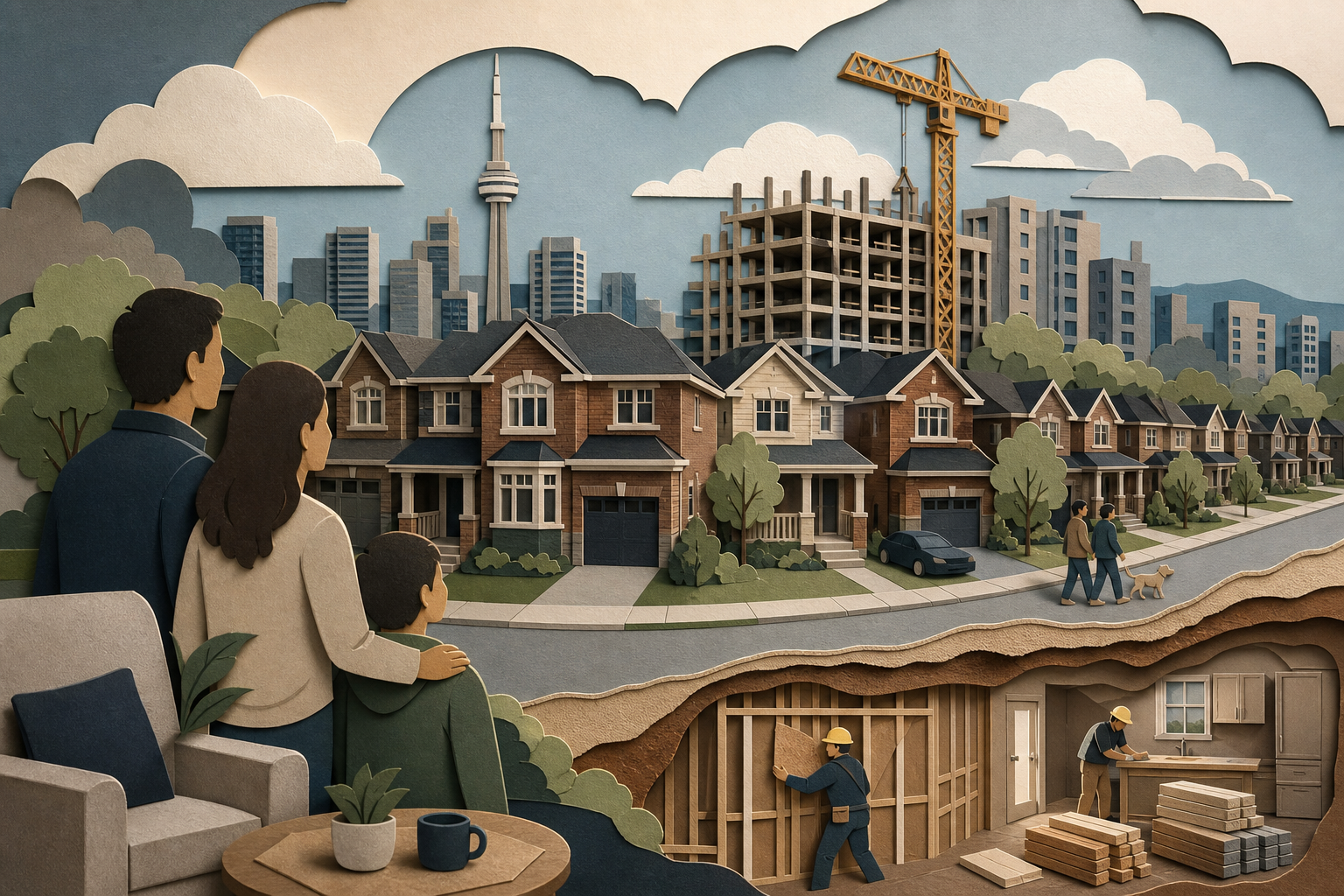
Existing homeowners with sub-3% mortgages from 2020 and 2021 aren't selling. They can't. A family sitting on a $750,000 mortgage at 2.1% would face a new rate north of 5.5% if they sold and bought something comparable today. That payment gap is $1,400 a month. So they stay. They renovate in place. They add the basement suite. They pull equity through a HELOC and improve what they have rather than move.
This "lock-in" keeps resale inventory tight, which keeps prices stable, which allows those same owners to access equity at relatively low cost compared to selling into a thin market with high buyer qualification thresholds. The homeowner with $380,000 in equity built up since 2018 can borrow against it at prime plus half a point, fund a renovation, and stay put. That's a wealth-building move in a low-volume market because the home's scarcity value isn't eroding.
The liquidity tradeoff
The honest counterpoint: scarcity value is only useful if you can find a buyer when you need one. Low transaction volume means longer days on market. If you must sell quickly, the pool of qualified buyers is smaller, approval times are longer, and you may have to price more aggressively to close. The home is worth more in theory but harder to monetize in practice. That's real.
But for the majority of Ontario homeowners not forced to sell in the next six months, the current environment is quietly working in their favor. Prices aren't collapsing because supply isn't flooding in. Equity stays intact. Debt pays down. And every quarter builders sit on their hands, your existing four walls edge closer to irreplaceable.
Low volume isn't a crisis for owners. It's a moat.



The Q2 tally showed 8,410 new-home transactions across Ontario, down from the roughly 12,000-unit quarterly average the province recorded before borrowing costs pushed past 5%. Most coverage treated this as confirmation of a frozen market. The logic seems obvious: fewer sales equals weaker demand, which should pressure prices downward. But that arithmetic only works if the supply side cooperates, and in Ontario right now, it isn't.
The scarcity mechanism nobody talks about
Here's what low new-home volume actually does. It cuts off the pipeline. Every year builders don't deliver finished units is a year the existing stock becomes harder to replace. Your 2014 semi in Etobicoke isn't competing with a row of sparkling new builds down the street. It's competing with a handful of resale listings and essentially nothing new. Scarcity doesn't require your home to be special. It just requires alternatives to be absent.
The math is simple. Ontario's own Ministry of Municipal Affairs estimates the province needs roughly 1.5 million new homes by 2031 to keep pace with population growth. That works out to 250,000 completions per year. Current starts are running 30,000 to 40,000 units below that. The gap compounds. Every month builders pause projects or shelve Phase 2, the distance between "homes people need" and "homes that exist" widens, and the homes already standing absorb the difference.
The replacement-cost floor
Construction costs haven't fallen. Labor shortages persist. Materials are up. A detached home in the Greater Toronto Area that sold for around $1,050,000 in early 2023 would cost materially more to build new today, even with current rates factored in. That creates a replacement-cost floor. If it costs $1,200,000 to build what you already own, the market has limited room to drop your existing home below that threshold without making construction economically nonsensical. Builders stop building, which tightens supply further, which props up your home's floor.
This is not theoretical. CMHC data from mid-2026 shows that despite transaction volume falling across major Ontario hubs, average prices in the GTA, Ottawa, and Kitchler-Waterloo have stayed within 3% of their 2024 peaks. Low volume didn't crater values. It preserved them by choking off new supply.
The lock-in effect doubles down
Existing homeowners with sub-3% mortgages from 2020 and 2021 aren't selling. They can't. A family sitting on a $750,000 mortgage at 2.1% would face a new rate north of 5.5% if they sold and bought something comparable today. That payment gap is $1,400 a month. So they stay. They renovate in place. They add the basement suite. They pull equity through a HELOC and improve what they have rather than move.
This "lock-in" keeps resale inventory tight, which keeps prices stable, which allows those same owners to access equity at relatively low cost compared to selling into a thin market with high buyer qualification thresholds. The homeowner with $380,000 in equity built up since 2018 can borrow against it at prime plus half a point, fund a renovation, and stay put. That's a wealth-building move in a low-volume market because the home's scarcity value isn't eroding.
The liquidity tradeoff
The honest counterpoint: scarcity value is only useful if you can find a buyer when you need one. Low transaction volume means longer days on market. If you must sell quickly, the pool of qualified buyers is smaller, approval times are longer, and you may have to price more aggressively to close. The home is worth more in theory but harder to monetize in practice. That's real.
But for the majority of Ontario homeowners not forced to sell in the next six months, the current environment is quietly working in their favor. Prices aren't collapsing because supply isn't flooding in. Equity stays intact. Debt pays down. And every quarter builders sit on their hands, your existing four walls edge closer to irreplaceable.
Low volume isn't a crisis for owners. It's a moat.
Read Next
How Dual Citizens Can Claim RESP Tax Benefits Without Form 3520 Reporting
Bond Markets Are Pricing In Recovery, Not the 1970s Replay Already Underway
Why Fortress Tells Private Credit Lenders to Stop Chasing AI Data Centre Deals
Canada's Tax Code Punishes Work and Rewards Wealth Hoarding: Four Reforms That Would Actually Fix It